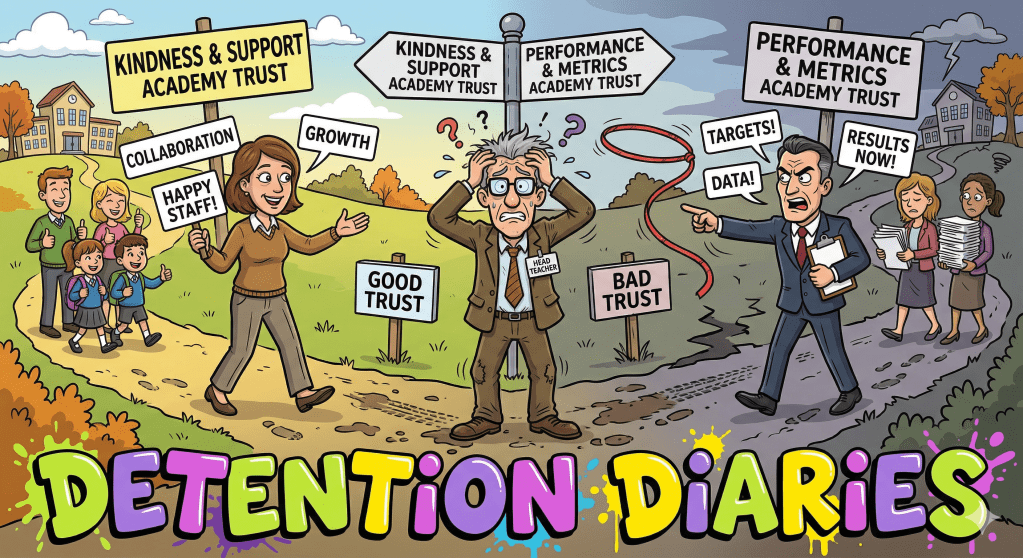
All schools are heading into academy trusts… and I’ll be honest:
I’m not convinced.
Not in a “tin foil hat, the government are watching me through my interactive whiteboard” kind of way.
More in a…
“Have you actually seen how different these trusts are?” kind of way.
The Grand Plan (Apparently)
The idea, in theory, is lovely.
Every school joins a Multi-Academy Trusts (MAT).
We get:
- Strong leadership
- Shared resources
- Consistency
- Collaboration
- Economies of scale
It’s like the educational version of the Avengers.
Different schools, different strengths… all coming together to save the day.
The Reality (Sometimes)
Some trusts are brilliant.
Let’s not pretend otherwise.
There are MATs out there doing incredible work:
- Supporting struggling schools
- Investing in staff
- Building real communities
- Actually improving outcomes
You walk into those schools and think:
“Yeah… this works.”
Then there are others…
Where it feels less like the Avengers…
and more like a group project where one person is doing all the work, three people are missing, and someone from central office has just emailed asking for a colour-coded spreadsheet by 3pm.
The Consistency Question
This is the bit that nags at me.
We keep hearing about “consistency” as the golden ticket.
But consistency of what, exactly?
Because MATs vary wildly:
- Leadership quality
- Funding allocation
- Staff support
- Behaviour policies
- Curriculum approaches
Some are slick, supportive, and well-run.
Others feel like:
“We’ve standardised the font on your PowerPoints… but behaviour is still chaos and you’ve got no glue sticks.”
Bigger Isn’t Always Better
There’s this underlying assumption that bigger = better.
More schools. More power. More efficiency.
But anyone who’s worked in education knows:
- Bigger can mean slower decisions
- Bigger can mean more layers
- Bigger can mean more distance from the classroom
At some point, “centralised support” becomes
“someone in an office 200 miles away deciding your marking policy.”
Lovely.
The Trust Lottery
Let’s be honest.
Joining a MAT can feel like spinning a wheel.
🎡 “Congratulations! You’ve landed on…”
- Supportive, well-funded, visionary trust
OR - Spreadsheet-heavy, policy-obsessed, where’s-the-money-going trust
Same system. Completely different experience.
And that’s the issue.
If we’re heading toward a system where all schools must join a trust… then surely the experience needs to be more consistent?
Otherwise we’re just institutionalising the postcode lottery.
Follow the Money (Always)
Here’s the uncomfortable bit.
When funding goes into a MAT, it doesn’t just drop neatly into classrooms.
It gets… distributed.
Filtered.
Managed.
Sliced.
And while many trusts absolutely reinvest well, there are always questions:
- How much reaches the classroom?
- How much is absorbed centrally?
- How transparent is it?
Because I’ve yet to meet a teacher who’s thought:
“You know what we’ve got too much of? Budget.”
Teacher Experience Matters (Shock)
We’re already losing teachers left, right and centre.
So any system change — especially one this big — has to ask:
“Will this make teachers’ lives better?”
Not:
- More paperwork
- More top-down directives
- More “non-negotiables” that ignore context
But actually better.
Because if it doesn’t?
We’re just rearranging deck chairs on the Titanic… but this time with a centralised behaviour policy.
So… Are There More Good Than Bad?
Honestly?
That’s the million-pound question.
And I don’t think anyone can answer it cleanly.
Because:
- Some MATs are exceptional
- Some are struggling
- Some are coasting
- Some are quietly falling apart behind a polished website
It’s not a simple good vs bad.
It’s a spectrum.
A very wide, very inconsistent spectrum.
The Bigger Concern
My scepticism isn’t about the idea of trusts.
It’s about making them mandatory.
Because once you remove choice, you raise the stakes massively.
If every school must be in a MAT, then:
- Quality has to be consistently high
- Accountability has to be razor sharp
- Transparency has to be crystal clear
Otherwise, we’re locking every school into a system that isn’t consistently working.
Final Thought
I’m not anti-MAT.
I’m anti-blind faith.
Some trusts are doing incredible things.
Others… need a long, hard look in the mirror.
Before we rush to a fully trust-led system, maybe the question isn’t:
“Should all schools join a MAT?”
Maybe it’s:
“Are all MATs good enough to justify that?”
Because right now?
It feels a bit like being told:
“Everyone must get on the bus.”
Without being told where it’s going.
Or who’s driving.
Or whether the wheels are even attached.
What do you think?
Are MATs the future of education — or are we building a system that’s not quite ready for everyone to be in it?
👇 Let’s get the conversation going over at Detention Diaries.

Leave a comment