I’ve just read this piece from
Tes
about Ofsted’s new framework and the way disadvantaged schools are being graded on “achievement”.
And honestly?
I’m furious.
Not surprised.
Not shocked.
Just… tired and furious.
The Headline That Says It All
Schools with the highest levels of disadvantage are:
Almost three times more likely to be graded down on achievement
Let that sink in.
Not slightly more likely.
Not marginally.
Three times.
And we’re still being told:
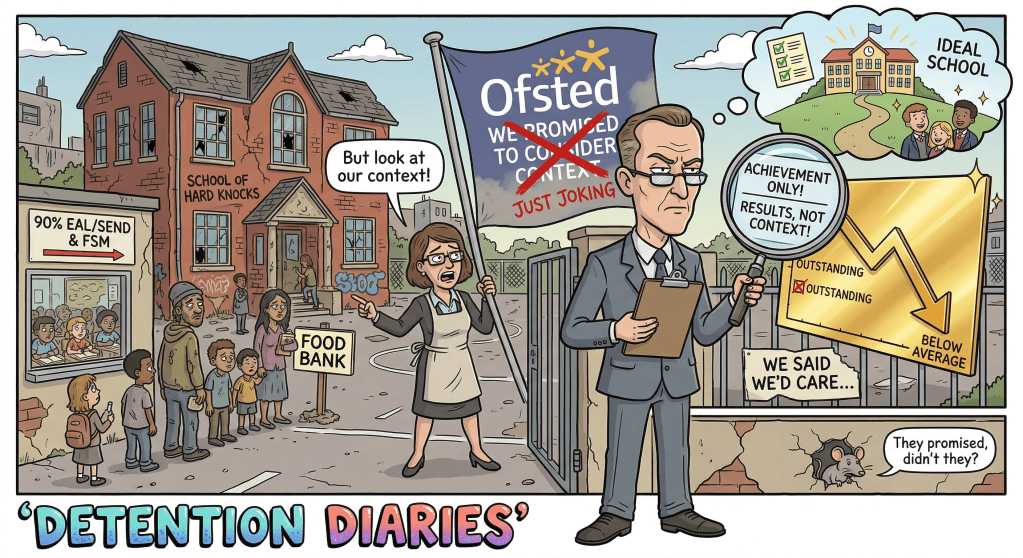
“Context is taken into account.”
Right.
Achievement vs Attainment (We All Know the Truth)
This is the bit that really gets me.
They’ve labelled it “achievement.”
But what they’re actually measuring is…
attainment.
Let’s call it what it is.
Because if the benchmark is:
- National averages
- Exam results
- Data comparisons
Then you are not measuring progress, journey, or distance travelled.
You are measuring:
“How close are your kids to everyone else?”
The Reality in Schools Like Mine
I work in a disadvantaged school.
I’ve lived this.
Multiple inspections. Multiple frameworks. Same story.
You take a child who:
- Arrives below expected levels
- Has barriers at home
- Attendance issues
- Social, emotional needs
And you move them forward.
You improve:
- Their confidence
- Their literacy
- Their behaviour
- Their chances
That is achievement.
Massive achievement.
Life-changing achievement.
But if their data doesn’t sit neatly alongside a national average?
“Needs attention.”
Cheers.
The “Secure Fit” Problem
Let’s talk about this idea of a secure-fit model.
You must meet every single descriptor to achieve a grade.
Every. Single. One.
Including:
Outcomes broadly in line with national averages
So even if:
- Teaching is strong
- Curriculum is solid
- Behaviour is improving
- SEND provision is effective
- Students are making progress
…but your data isn’t quite there?
You don’t get the grade.
That’s not nuance.
That’s a checklist.
And schools in disadvantaged areas are being caught out by it — not because they’re failing…
…but because the system is built in a way that makes it harder for them to succeed.
“We Don’t Ignore Context”
This line always comes out.
And every time I hear it, I think:
“You might not ignore it… but you’re definitely not weighting it properly.”
Because if context truly mattered, you wouldn’t see a gap this big.
You wouldn’t see:
- 33% of high FSM schools below expected
vs - 12% of low FSM schools
That’s not coincidence.
That’s structural.
The Bit That Really Worries Me
It’s not just about grades.
It’s about people.
Headteachers calling the system:
- “Demoralising”
- “Unfair”
Leaders in the toughest schools being told:
“What you’re doing isn’t enough.”
Even when they’re moving mountains.
And here’s the kicker…
These are the schools we most need to:
- Support
- Invest in
- Retain staff in
Instead?
We risk:
- Burning leaders out
- Driving teachers away
- Labelling schools unfairly
The Big Contradiction
We were told the reforms would:
- Be fairer
- Consider context
- Move away from crude judgements
And on paper?
It sounds great.
Even hopeful.
But if this data is anything to go by…
It’s exactly what one leader said:
“The old system wearing new clothes.”
Let’s Be Honest
This isn’t about lowering expectations.
No one is saying:
“Let disadvantaged children achieve less.”
That’s not the argument.
The argument is:
“Measure success properly.”
Because success in a leafy suburb and success in a high-deprivation area do not look the same.
They shouldn’t be judged the same way.
Final Thought
If your system consistently tells the most challenging schools:
“You’re not good enough.”
…then one of two things is true:
- Those schools are all failing
- The system is flawed
And I know which one I believe.
Ofsted needs to take a long, hard look at this.
Because right now?
It doesn’t feel like context is being considered.
It feels like it’s being politely acknowledged…
and then completely ignored.
What’s your experience?
If you work in a disadvantaged school — does this reflect what you’re seeing?
Let’s have the conversation over at Detention Diaries 👇

Leave a comment