• Should I Be Feeling Guilty?

    There is nothing wrong with having a break. Remember that, please!

    There is nothing wrong with having a break. Remember that, please!

    School life is full-on — we all know that. It’s relentless pressure from an industry (and often an employer) that just wants more, more, more. Some of us are staring at a glass ceiling with zero chance of financial reward for working harder. And we’re flat out — physically, mentally, and, most of all (especially if you’re in a school like mine), emotionally.

    And that, my friends, is the silent killer — the thing teachers struggle to put into words. It’s very hard to empathise with educators if you’ve never stepped foot in a school beyond your own teenage years. And especially in schools like mine, where a high proportion of students come from disadvantaged backgrounds.

    In this kind of setting, it’s a bit like riding a rollercoaster operated by an emotionally unstable teenager. You get some intense highs — the kind that make your heart soar — but also some stomach-lurching lows that leave you wondering why you ever got on the ride in the first place.

    The highs?
    Oh, those beautiful lightbulb moments. You know the ones — when someone inevitably asks, “But why do you do it?” and you say something about “making a difference.” Well, those lightbulbs flash brighter and more frequently in tough schools (in my humble opinion) because the kids often haven’t had the same academic head start. I’ve taken students camping who’d never left their estate, let alone been on a holiday. Watching them toast marshmallows under the stars, eyes wide with joy — honestly, awesome!

    The lows?
    Well… brace yourself. As the pressure on public services builds — with NHS backlogs and a CAMHS system that’s basically being held together with chewing gum and a “please try again later” sign — both students and staff are burning out. Mondays (especially the post-holiday ones) are like opening Pandora’s inbox. Police reports, domestic violence files, children who’ve lost their homes… and somehow we, the teachers, are left to pick up the pieces and often manage the situation..

    But I digress. I’m not here to rage about the crumbling school system (I’ll save that joy for another post). Today, this is about you understanding that it is absolutely, 100% OK to switch off.

    You spend 195 days a year in GO mode. Full speed. Eyes wide. Heart on the line. So now, it’s time to breathe. To take stock. To feel proud of yourself. To give yourself a massive pat on the back and to spend your time doing things that matter to you.

    So if you fancy drinking gin on a Tuesday morning in your underwear — do it.
    If you feel like launching your slipper at the TV every time a “back to school” ad pops up in July, please, be my guest (just don’t use one of those reinforced all-terrain slippers you can sprint in — you might end up spending your summer pay packet on a new telly).

    And remember: it’s OK to say no.
    Just because you’ve got “lots of time off” doesn’t mean your time is any less valuable. If you’ve been dodging that catch-up coffee with a friend who drains your soul more than a Year 9 wet break duty — bin it off. You’re allowed to be selfish. You’re allowed to rest. You’re allowed to recharge your batteries without guilt.

    You’ve earned it. Honestly.

    Have Your Say 🎙

    Whether you’re a teacher, student, parent – or just someone with a funny school story or a strong opinion about education – we want to hear from you! Share your thoughts, stories, or ideas and we might feature them on an upcoming episode of the podcast.

    Join the Detention Diaries Community

    We’re just getting started – and there’s so much more to come!
    🎧 Follow our brand-new podcast for honest chats, special guests, and real talk about life in education.
    📝 Subscribe to the blog for stories, insights, and updates.
    📬 Join the waitlist to be the first to access our exclusive teacher community, packed with valuable content, mindfulness tools, giveaways, and exciting early-access perks like our upcoming teacher planners.

    Be part of something that supports, entertains and inspires educators – head to www.detentiondiaries.com and get involved!
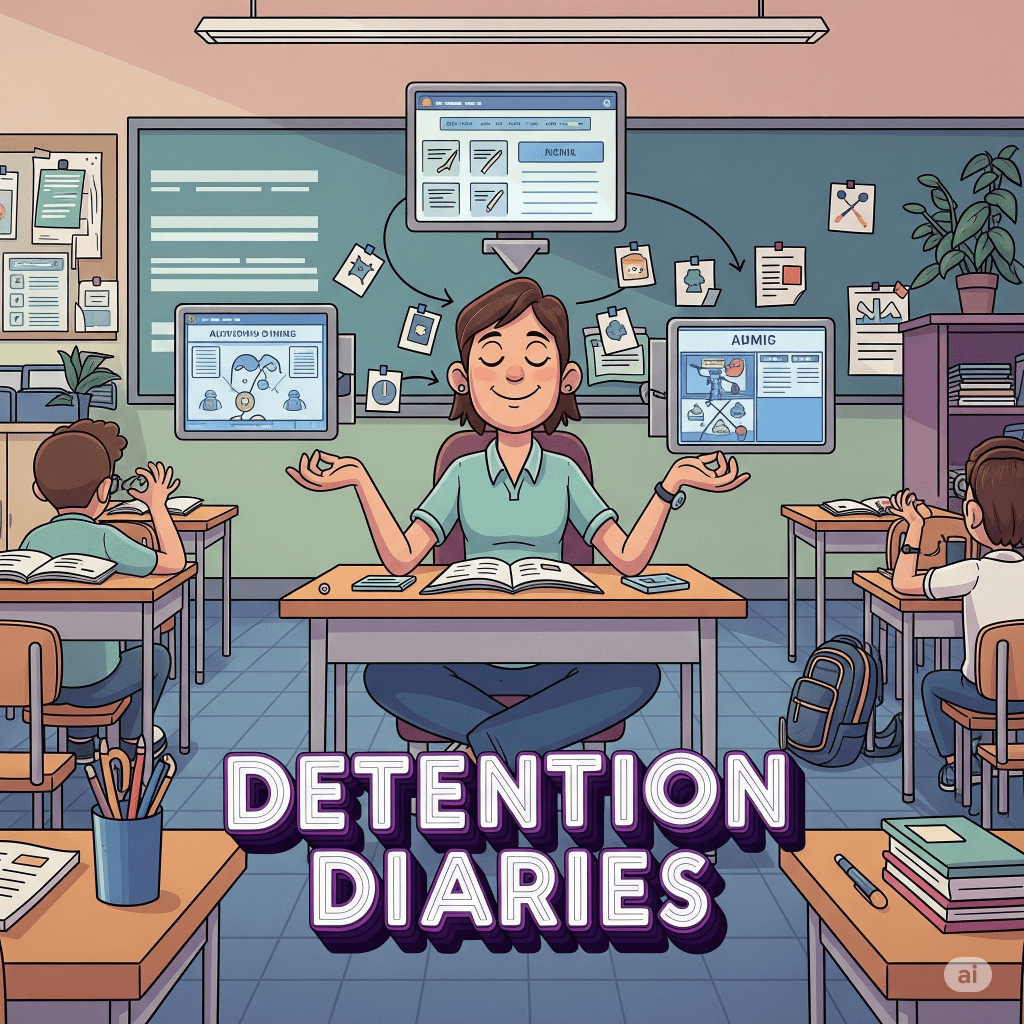

  • How can we create our own systems to lighten our workload?

    I have been reading ‘The 4 hour work week’ by Timothy Ferriss, the premise of the book is to automate a lot of what you do, eliminate distractions, say no to things that don’t interest or serve you and to start to think about working remotely with the eventual goal of creating a business or an idea to allow you to work a short amount of time each week as you become more of a passive operator, allowing others to handle much of your administrative work and

    Although I do think AI and remote working will become more mainstream in education. Some schools already allow teachers to spend their PPA time at home, particularly in primary school. I think it is a little more difficult to accomplish in a secondary setting – I can’t see my school doing that any time soon.

    The book is essentially full of tips and tricks to move more towards automating your life and to slim down the amount of time you spend completing menial tasks. Tim encourages the use of virtual assistants and tries to limit his time responding to emails and managing the minutiae so he can spend his time travelling, learning and working creatively on his business.

    This got me thinking, how can we as teachers start to implement these methods and how far can we possibly go?

    When I first picked up The 4-Hour Workweek by Tim Ferriss, I assumed it was either a satire or a manual for tech bros who make millions by selling NFTs of their houseplants. Turns out, it’s actually packed with genuinely helpful ideas — even for us humble UK teachers chained to our marking piles and duty rotas.

    Ferriss’s big idea? Stop working harder. Start working smarter (no, really smarter — not “doing a PowerPoint instead of writing on the board” smarter). His framework is called DEAL: Definition, Elimination, Automation, Liberation. And no, sadly, it doesn’t include “Deportation to Bali with a coconut laptop.” But stick with me — here’s how teachers can apply it:


    D – Definition: Redefine What “Success” Means

    Ferriss starts by throwing out the idea that success = long hours. Preach. In teaching, we often treat working late as a badge of honour, like some sort of tragic educational gladiator sport. But what if we measured success by impact, not hours?

    💡 Teacher tweak:
    Start asking: “What actually helps students learn?” Spoiler alert: it’s probably not that six-page seating plan colour-coded by blood type. Use “fear-setting” (one of Ferriss’s tools) to get over the guilt of not being the last one to leave the car park. What’s the worst that could happen if you leave your display board looking “adequate” instead of “Pinterest-worthy”?


    E – Elimination: Stop Doing Stuff That Doesn’t Matter

    Ferriss is big on the 80/20 rule — 80% of results come from 20% of what you do. The rest is noise. In teacher terms:

    • 80% of learning comes from 20% of your lessons (usually the ones where you remembered to print the worksheet).
    • 80% of behaviour issues come from 20% of students (you know the ones).

    💡 Teacher tweak:

    • Ditch the pointless admin and campaign for less of it – can one of the admin team do that, just ask.
    • Cap meetings. Suggest a “This Could Have Been an Email” badge. Ask for an agenda for EVERY meeting and stick to it. Once that agenda is completed – you take your leave.
    • Reduce marking to what actually makes a difference. This is a tough one as you will need to stick to your school marking policy, but can you create rubrics for each SOW you have and use AI to assign the correct feedback comments to each students (we’ll talk about AI a lot more going forward)
    • Give yourself permission to be a “good enough” planner. If you know what you’re doing, does it matter? Embrace the mess and allow yourself to be more fluid.

    And remember: perfectionism is just procrastination in a sparkly hat.


    A – Automation: Build Systems, Not Stress

    No, you can’t outsource your Y9s to a virtual assistant (yet). But you can automate your workflow.

    💡 Teacher tweak:

    • Set up self-marking quizzes. Most schools now use google classroom or Microsoft Office, both of these have fantastic methods of delivering homework with self marking capabilities – get on YouTube and figure out how to do it or, find the nerd (usually in the IT dept) in your school to help you out!
    • Batch your emails and focus only on reading them at specific times of the day – don’t be afraid to add an auto reply letting staff know that you will only be checking emails at certain times of the day (Tim Ferris has a fantastic, and polite, template for you, let me know in the comments if you’d like a copy)
    • Reuse feedback codes or stickers instead of writing War and Peace on every essay.
    • Build resource banks with your department so you’re not all inventing the wheel at midnight with a sad biscuit.

    Basically, create little systems now that save your sanity later.


    L – Liberation: Escape the Busyness Cult

    Ferriss is obsessed with freedom — and while we can’t all teach from a hammock in Barbados, we can challenge the idea that being a burnt-out husk makes you a better educator.

    💡 Teacher tweak:

    • Push for flexible working (job shares, work-from-home PPA, or just fewer meetings with biscuits).
    • Focus on outputs over face time — it’s what your students learn, not how long you spent at your desk.
    • Take your “mini-retirements” seriously: protect weekends, use your TOIL, and for heaven’s sake stop answering emails at 9pm.

    TL;DR – You’re Allowed to Teach Smart, Not Just Hard

    The 4-Hour Workweek isn’t about abandoning the classroom. It’s about ditching the unnecessary nonsense so you can focus on what actually matters: inspiring young minds, enjoying your job, and maybe even having a life outside of it.

    It’s not about working four hours. But it is about making the other 36 feel less like a treadmill and more like a purposeful, well-caffeinated stroll.

    Have Your Say 🎙️

    Whether you’re a teacher, student, parent – or just someone with a funny school story or a strong opinion about education – we want to hear from you! Share your thoughts, stories, or ideas and we might feature them on an upcoming episode of the podcast.

    Join the Detention Diaries Community

    We’re just getting started – and there’s so much more to come!
    🎧 Follow our brand-new podcast for honest chats, special guests, and real talk about life in education.
    📝 Subscribe to the blog for stories, insights, and updates.
    📬 Join the waitlist to be the first to access our exclusive teacher community, packed with valuable content, mindfulness tools, giveaways, and exciting early-access perks like our upcoming teacher planners.

    Be part of something that supports, entertains and inspires educators – head to www.detentiondiaries.com and get involved!

  • The Disgruntled Teacher… I think?

    My name’s Dan. I’m a secondary school teacher in the North of England, and I’ve been doing this job for ten years. My wife is a teacher too, and together we have two young kids – they’re 6 and 4. Our eldest is autistic, but she’s in mainstream education and doing well – she has her moments, but we all do.

    Right now, I find myself experiencing education from a variety of perspectives: as a teacher, a parent, a partner and as an advocate of SEND provision (or lack thereof). I’ll talk more about these different roles in future posts. But first, let me rewind a bit.

    Before anything else, I was a teacher – a decent one, I think. I’m not especially organised. I’m rubbish at paperwork. And don’t come to me for insightful tech advice (which, let’s be honest, is probably just another way of saying I’m disorganised). But what I am good at is people. I genuinely care about them.

    In my younger years, that came from a desire to please everyone – but over time, it’s grown into something more grounded. I’ve learned how to build rapport with all sorts of people, and I pride myself on leaving someone feeling just a tiny bit better than when I met them. At least, that’s the aim.

    But recently, something’s shifted.

    Most mornings, I wake up and try to get myself and the kids ready for the day. And then – like clockwork – the ‘schedule send’ emails arrive. Always at 7:30am. Someone, somewhere, once sat around a table and decided that 7:30am is the official start of our working day.

    Those emails hit, and I feel it – a surge of frustration. Not aimed at anyone in particular, but at the system, maybe? Or just… how dare you email me now? I’m already forcing Cheerios into my kids while realising I haven’t ironed my shirt or made my wife’s packed lunch like I said I would.

    Is this a me problem?

    Most mornings follow a strict routine (my eldest needs it), but I still somehow manage to sabotage things with my trademark tardiness and shambolic household admin. By the time we’re out the door, I’m already in a bit of a negative headspace. But then – as always – I’m proven wrong.

    It’s like going to see a film you didn’t want to watch. Your mates are buzzing about it, but you were hoping for the big-budget action flick with that actress from the perfume advert. Instead, you end up watching a rom-com where Jack Black is the romantic lead, and before you know it, you’re crying into your popcorn thinking, what a way to spend Christmas. (Totally made-up example, by the way.)

    That’s what teaching feels like most days.

    I think I hate it. I really do. There are definitely parts of the job I can’t stand. But as the day goes on – as I spend more time with the kids (who, for the most part, are actually amazing) – I feel myself getting happier, more energised.

    So… do I secretly love a job I outwardly complain about? Or am I just clinging to the good bits, trying to balance them against the weight of a profession that doesn’t seem to be valued by many of the people who should care most?

    I’m not sure yet.

    But I think that’s why I’m writing this blog. SO, please like and subscribe – join us for the Detention Diaries podcast where we will be discussing all things education and have a little bit of fun while we’re at it.

    Have Your Say 🎙️

    Whether you’re a teacher, student, parent – or just someone with a funny school story or a strong opinion about education – we want to hear from you! Share your thoughts, stories, or ideas and we might feature them on an upcoming episode of the podcast.

    Join the Detention Diaries Community

    We’re just getting started – and there’s so much more to come!
    🎧 Follow our brand-new podcast for honest chats, special guests, and real talk about life in education.
    📝 Subscribe to the blog for stories, insights, and updates.
    📬 Join the waitlist to be the first to access our exclusive teacher community, packed with valuable content, mindfulness tools, giveaways, and exciting early-access perks like our upcoming teacher planners.

    Be part of something that supports, entertains and inspires educators – head to www.detentiondiaries.com and get involved!

Detention Diaries

Exploring Education, building a community

Skip to content ↓