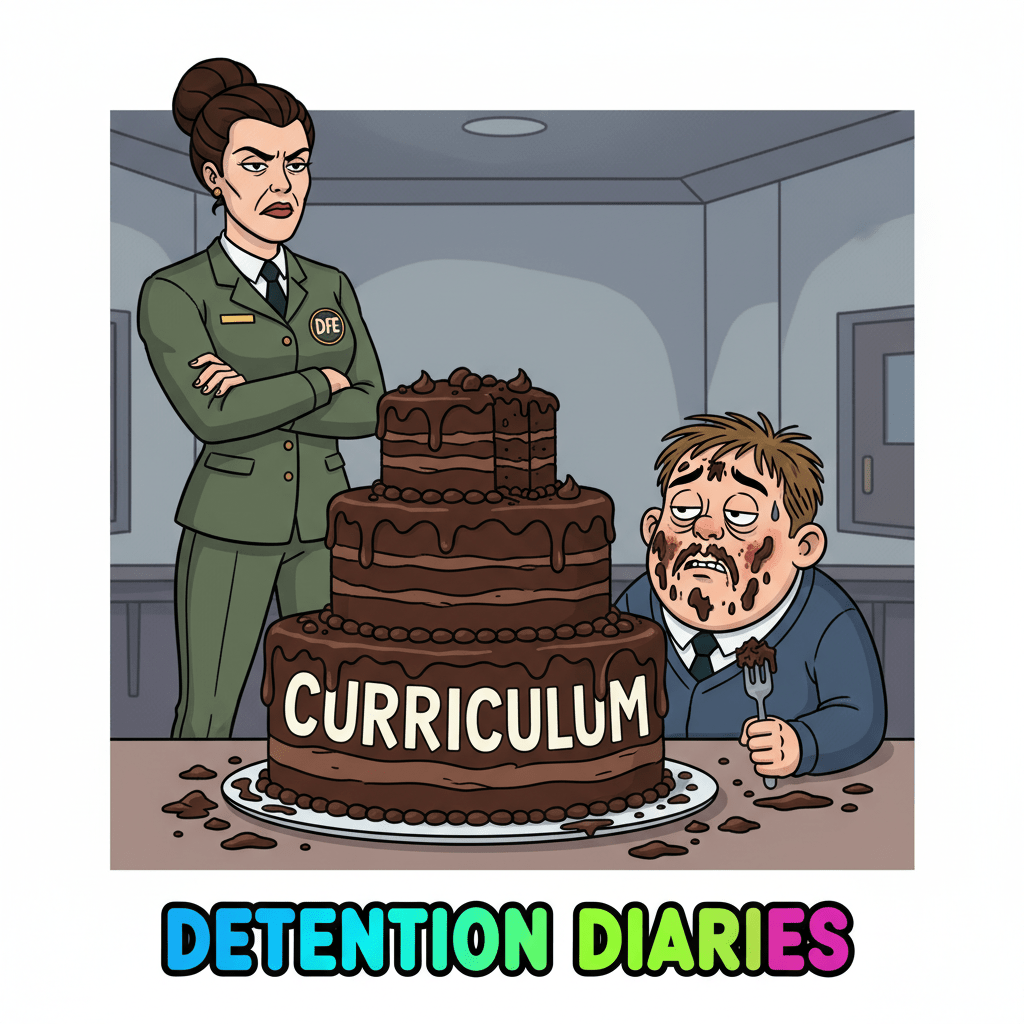
So, the new curriculum reform guidance has finally been published this week — and, to be fair, there’s a lot to like.
There’s talk of citizenship education, AI literacy, even understanding mortgages (which, frankly, would’ve been handy before I recently signed up for one).
Finally, it feels like someone in the Department for Education has realised that maybe — just maybe — children need to understand the world they’re actually living in, not just what a fronted adverbial is.
But as always, there’s a catch.
Because while we’re talking about adding more wonderful things to the curriculum, there’s been absolutely no talk about taking anything out.
And the curriculum is already so full it’s practically bursting at the seams.
Bruce Bogtrotter and the National Curriculum
If you’ve ever watched Matilda, you’ll remember Bruce Bogtrotter — the poor lad forced by Miss Trunchbull to eat an entire chocolate cake the size of a car tyre in front of the whole school.
That, in a nutshell, is our curriculum.
Students are handed an ever-growing mountain of content, told to eat every last bite, and then made to sit around 30 exams in three or four weeks.
They struggle. They stress. They soldier on.
And somehow — with a bit of teamwork and a lot of resilience — they pull through.
And then, just when they think it’s over… Miss Trunchbull smashes the plate over their head.
Pretty similar to real life after school, isn’t it?
(Though perhaps best not to mention that bit during Year 11 assembly.)
Adding Without Subtracting
Don’t get me wrong — curriculum reform is absolutely needed.
It’s overdue, in fact.
But there’s a limit to how much you can add before the whole thing collapses under its own weight.
We can’t just keep cramming in AI, citizenship, personal finance, and mental health awareness without removing something else.
That’s like being served your fifth helping of cake while the waiter insists it’s for your own good.
Schools are already overstretched, underfunded, and losing staff faster than we can recruit them.
So where, exactly, is the time going to come from to “embed” all these new areas?
Are we supposed to do it between the Year 10 mocks and the cover lesson for someone off with flu?
The guidance reads like a wish list written by people who’ve forgotten that teachers aren’t wizards.
We can’t conjure extra hours in the day or extra funding out of thin air — though, if that was on the curriculum, I’d teach it in a heartbeat.
Farewell to the EBacc (And Not a Tear Shed)
Now, on to some good news: it looks like the EBacc — that long-standing thorn in the side of creative education — is finally on its way out.
Let’s be honest, the EBacc has done more damage to creative arts education than any single policy in recent memory.
It squeezed out music, art, drama, and design to make room for an academic core that left little space for creativity, expression, or the sort of learning that actually makes school joyful.
So yes — I’m delighted to see signs of change.
Because maybe now we can stop pretending that creativity is optional, or something to be squeezed in during tutor time.
Maybe now we can rebuild the arts properly — with funding, recognition, and most importantly, time.
Because every time the government decides to “update the framework,” we’re expected to reinvent our entire curriculum like we’re working on a reboot of The Great British Bake Off.
Except there’s no tent, no applause, and definitely no budget for new ingredients.
A Final Slice of Realism
So yes, the reforms have promise — citizenship, AI, real-world knowledge — all great ideas in theory.
But here’s the thing: before we start adding new flavours, we need to make room on the plate.
Because right now, teachers and students alike are Bruce Bogtrotter — sitting at the table, staring at the cake, wondering how on earth we’re supposed to finish it all.
And if the DfE keeps piling more on top without taking anything off, we’ll all end up sick, sticky, and muttering something about how “at least the sponge was moist.”
The curriculum doesn’t need more.
It needs less — better, deeper, simpler, more human.
Otherwise, the only people learning anything will be the ones discovering just how far you can push a teacher before they snap and start marking in interpretive dance.

Leave a comment