• “Context Matters”… Does It Though?

    I’ve just read this piece from
    Tes
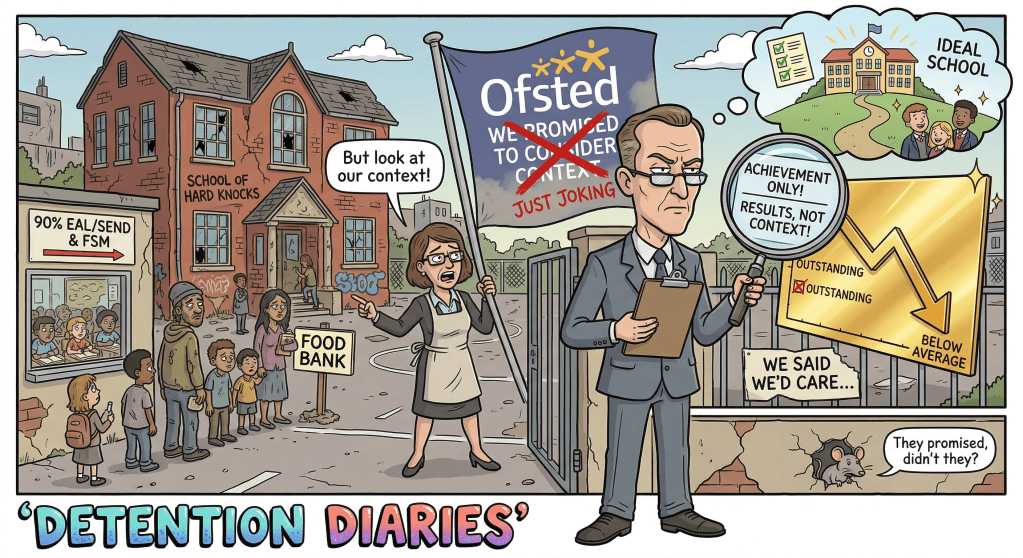
    about Ofsted’s new framework and the way disadvantaged schools are being graded on “achievement”.

    And honestly?

    I’m furious.

    Not surprised.
    Not shocked.
    Just… tired and furious.


    The Headline That Says It All

    Schools with the highest levels of disadvantage are:

    Almost three times more likely to be graded down on achievement

    Let that sink in.

    Not slightly more likely.
    Not marginally.

    Three times.

    And we’re still being told:

    “Context is taken into account.”

    Right.


    Achievement vs Attainment (We All Know the Truth)

    This is the bit that really gets me.

    They’ve labelled it “achievement.”

    But what they’re actually measuring is…
    attainment.

    Let’s call it what it is.

    Because if the benchmark is:

    • National averages
    • Exam results
    • Data comparisons

    Then you are not measuring progress, journey, or distance travelled.

    You are measuring:

    “How close are your kids to everyone else?”


    The Reality in Schools Like Mine

    I work in a disadvantaged school.

    I’ve lived this.

    Multiple inspections. Multiple frameworks. Same story.

    You take a child who:

    • Arrives below expected levels
    • Has barriers at home
    • Attendance issues
    • Social, emotional needs

    And you move them forward.

    You improve:

    • Their confidence
    • Their literacy
    • Their behaviour
    • Their chances

    That is achievement.

    Massive achievement.

    Life-changing achievement.


    But if their data doesn’t sit neatly alongside a national average?

    “Needs attention.”

    Cheers.


    The “Secure Fit” Problem

    Let’s talk about this idea of a secure-fit model.

    You must meet every single descriptor to achieve a grade.

    Every. Single. One.

    Including:

    Outcomes broadly in line with national averages

    So even if:

    • Teaching is strong
    • Curriculum is solid
    • Behaviour is improving
    • SEND provision is effective
    • Students are making progress

    …but your data isn’t quite there?

    You don’t get the grade.


    That’s not nuance.

    That’s a checklist.

    And schools in disadvantaged areas are being caught out by it — not because they’re failing…

    …but because the system is built in a way that makes it harder for them to succeed.


    “We Don’t Ignore Context”

    This line always comes out.

    And every time I hear it, I think:

    “You might not ignore it… but you’re definitely not weighting it properly.”

    Because if context truly mattered, you wouldn’t see a gap this big.

    You wouldn’t see:

    • 33% of high FSM schools below expected
      vs
    • 12% of low FSM schools

    That’s not coincidence.

    That’s structural.


    The Bit That Really Worries Me

    It’s not just about grades.

    It’s about people.

    Headteachers calling the system:

    • “Demoralising”
    • “Unfair”

    Leaders in the toughest schools being told:

    “What you’re doing isn’t enough.”

    Even when they’re moving mountains.


    And here’s the kicker…

    These are the schools we most need to:

    • Support
    • Invest in
    • Retain staff in

    Instead?

    We risk:

    • Burning leaders out
    • Driving teachers away
    • Labelling schools unfairly

    The Big Contradiction

    We were told the reforms would:

    • Be fairer
    • Consider context
    • Move away from crude judgements

    And on paper?

    It sounds great.

    Even hopeful.


    But if this data is anything to go by…

    It’s exactly what one leader said:

    “The old system wearing new clothes.”


    Let’s Be Honest

    This isn’t about lowering expectations.

    No one is saying:

    “Let disadvantaged children achieve less.”

    That’s not the argument.

    The argument is:

    “Measure success properly.”

    Because success in a leafy suburb and success in a high-deprivation area do not look the same.

    They shouldn’t be judged the same way.


    Final Thought

    If your system consistently tells the most challenging schools:

    “You’re not good enough.”

    …then one of two things is true:

    1. Those schools are all failing
    2. The system is flawed

    And I know which one I believe.


    Ofsted needs to take a long, hard look at this.

    Because right now?

    It doesn’t feel like context is being considered.

    It feels like it’s being politely acknowledged…

    and then completely ignored.


    What’s your experience?

    If you work in a disadvantaged school — does this reflect what you’re seeing?

    Let’s have the conversation over at Detention Diaries 👇
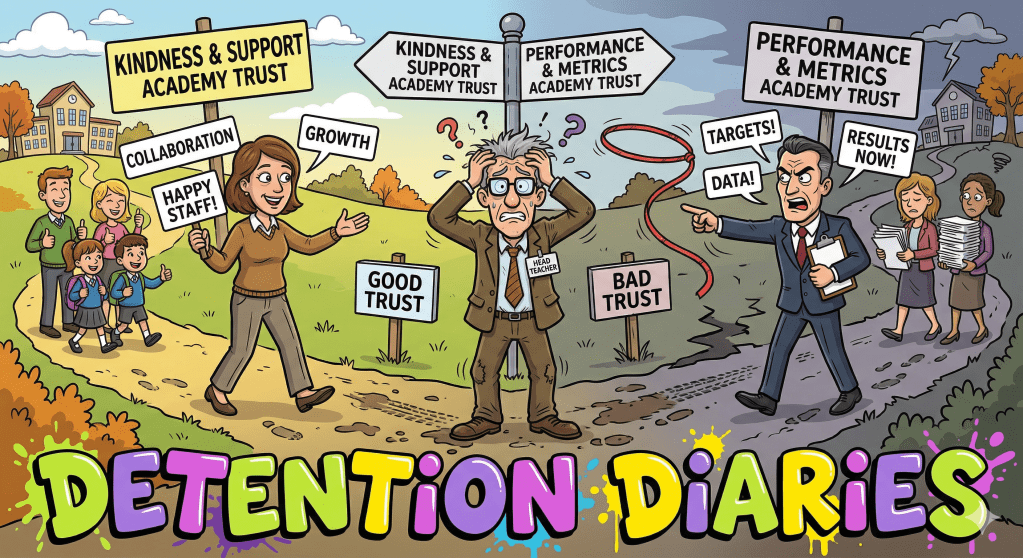
  • Will All Schools Join a Trust? …Pull the Other One.

    All schools are heading into academy trusts… and I’ll be honest:

    I’m not convinced.

    Not in a “tin foil hat, the government are watching me through my interactive whiteboard” kind of way.

    More in a…
    “Have you actually seen how different these trusts are?” kind of way.


    The Grand Plan (Apparently)

    The idea, in theory, is lovely.

    Every school joins a Multi-Academy Trusts (MAT).
    We get:

    • Strong leadership
    • Shared resources
    • Consistency
    • Collaboration
    • Economies of scale

    It’s like the educational version of the Avengers.

    Different schools, different strengths… all coming together to save the day.


    The Reality (Sometimes)

    Some trusts are brilliant.

    Let’s not pretend otherwise.

    There are MATs out there doing incredible work:

    • Supporting struggling schools
    • Investing in staff
    • Building real communities
    • Actually improving outcomes

    You walk into those schools and think:

    “Yeah… this works.”


    Then there are others…

    Where it feels less like the Avengers…
    and more like a group project where one person is doing all the work, three people are missing, and someone from central office has just emailed asking for a colour-coded spreadsheet by 3pm.


    The Consistency Question

    This is the bit that nags at me.

    We keep hearing about “consistency” as the golden ticket.

    But consistency of what, exactly?

    Because MATs vary wildly:

    • Leadership quality
    • Funding allocation
    • Staff support
    • Behaviour policies
    • Curriculum approaches

    Some are slick, supportive, and well-run.

    Others feel like:

    “We’ve standardised the font on your PowerPoints… but behaviour is still chaos and you’ve got no glue sticks.”


    Bigger Isn’t Always Better

    There’s this underlying assumption that bigger = better.

    More schools. More power. More efficiency.

    But anyone who’s worked in education knows:

    • Bigger can mean slower decisions
    • Bigger can mean more layers
    • Bigger can mean more distance from the classroom

    At some point, “centralised support” becomes
    “someone in an office 200 miles away deciding your marking policy.”

    Lovely.


    The Trust Lottery

    Let’s be honest.

    Joining a MAT can feel like spinning a wheel.

    🎡 “Congratulations! You’ve landed on…”

    • Supportive, well-funded, visionary trust
      OR
    • Spreadsheet-heavy, policy-obsessed, where’s-the-money-going trust

    Same system. Completely different experience.

    And that’s the issue.

    If we’re heading toward a system where all schools must join a trust… then surely the experience needs to be more consistent?

    Otherwise we’re just institutionalising the postcode lottery.


    Follow the Money (Always)

    Here’s the uncomfortable bit.

    When funding goes into a MAT, it doesn’t just drop neatly into classrooms.

    It gets… distributed.

    Filtered.

    Managed.

    Sliced.

    And while many trusts absolutely reinvest well, there are always questions:

    • How much reaches the classroom?
    • How much is absorbed centrally?
    • How transparent is it?

    Because I’ve yet to meet a teacher who’s thought:

    “You know what we’ve got too much of? Budget.”


    Teacher Experience Matters (Shock)

    We’re already losing teachers left, right and centre.

    So any system change — especially one this big — has to ask:

    “Will this make teachers’ lives better?”

    Not:

    • More paperwork
    • More top-down directives
    • More “non-negotiables” that ignore context

    But actually better.

    Because if it doesn’t?

    We’re just rearranging deck chairs on the Titanic… but this time with a centralised behaviour policy.


    So… Are There More Good Than Bad?

    Honestly?

    That’s the million-pound question.

    And I don’t think anyone can answer it cleanly.

    Because:

    • Some MATs are exceptional
    • Some are struggling
    • Some are coasting
    • Some are quietly falling apart behind a polished website

    It’s not a simple good vs bad.

    It’s a spectrum.

    A very wide, very inconsistent spectrum.


    The Bigger Concern

    My scepticism isn’t about the idea of trusts.

    It’s about making them mandatory.

    Because once you remove choice, you raise the stakes massively.

    If every school must be in a MAT, then:

    • Quality has to be consistently high
    • Accountability has to be razor sharp
    • Transparency has to be crystal clear

    Otherwise, we’re locking every school into a system that isn’t consistently working.


    Final Thought

    I’m not anti-MAT.

    I’m anti-blind faith.

    Some trusts are doing incredible things.
    Others… need a long, hard look in the mirror.

    Before we rush to a fully trust-led system, maybe the question isn’t:

    “Should all schools join a MAT?”

    Maybe it’s:

    “Are all MATs good enough to justify that?”

    Because right now?

    It feels a bit like being told:

    “Everyone must get on the bus.”

    Without being told where it’s going.
    Or who’s driving.

    Or whether the wheels are even attached.


    What do you think?

    Are MATs the future of education — or are we building a system that’s not quite ready for everyone to be in it?

    👇 Let’s get the conversation going over at Detention Diaries.

  • When SEND Funding Gets “Swallowed”: Who Actually Sees the Money?

    Every so often a headline appears that makes teachers across the country quietly mutter “well… yes… obviously.”

    This week it was from TES:

    “Leaders warn SEND funds may get ‘swallowed’ up.”

    For anyone working in schools, particularly those in disadvantaged areas, this won’t come as a shock. It simply confirms what many of us already suspect: new SEND funding risks disappearing somewhere in the system long before it reaches the children who need it.

    And that system increasingly runs through multi-academy trusts (MATs).


    The SEND Funding Problem: A System Under Pressure

    Before we even get into MAT structures, we need to acknowledge the context.

    SEND provision in England is already under enormous strain.

    According to the National Audit Office:

    • The high needs deficit is expected to exceed £4 billion across local authorities.
    • Demand for Education Health and Care Plans (EHCPs) has more than doubled since 2014.
    • Schools are increasingly expected to meet complex needs from existing budgets.

    The Education Policy Institute has also found that:

    • Schools often spend far more on SEND support than they receive in funding.
    • Many SEND pupils are supported without formal plans because the system is too slow or overstretched.

    So when government announcements promise new funding, teachers understandably hope it will actually reach the frontline.

    But that’s where the concern begins.


    The MAT Structure: Where the Money Flows

    Multi-academy trusts now run over half of all schools in England.

    The theory behind them was simple:

    • Shared resources
    • Centralised expertise
    • Economies of scale

    But in practice, funding flows through layers of management structures before reaching classrooms.

    Typical MAT financial structures include:

    Spending AreaDescription
    Central Trust ServicesFinance teams, HR, estates, data teams
    Executive LeadershipCEOs, deputy CEOs, regional directors
    School LeadershipHeadteachers and local leadership teams
    Classroom ProvisionTeachers, TAs, resources

    SEND funding technically goes to schools — but within MATs budgets are often pooled or centrally controlled.

    This is where the phrase “swallowed up” starts to make sense.


    Executive Pay vs Classroom Support

    One of the most controversial aspects of MAT structures is executive remuneration.

    Research from the Sutton Trust and reporting from TES show:

    • Over 100 academy trust CEOs earn more than £150,000
    • Some lead trusts with fewer than 10 schools
    • Pay increases have occurred while school budgets remain under pressure

    To put that into perspective:

    CostEquivalent SEND Support
    £150,000 CEO salary~5 Teaching Assistants
    £200,000 executive package~6–7 TAs
    £300,000 leadership structureEntire SEND department in some schools

    Of course, large organisations need leadership.

    But the concern many school leaders raise is simple:

    How much of the new SEND funding will actually reach classrooms rather than organisational structures?


    What School Leaders Are Actually Warning

    The TES article reported concerns from school leaders that:

    • New funding may not be ring-fenced
    • Trust centralisation may absorb the money
    • Schools may still be expected to fund support from existing budgets

    In other words, SEND funding risks becoming a balancing tool for trust finances rather than targeted support for pupils.

    And if that happens, the consequences are predictable.


    What SEND Support Actually Costs

    To understand the scale of the issue, consider what effective SEND provision typically requires:

    SupportApprox Cost per Year
    Teaching Assistant (full time)£25k–£30k
    Specialist SEND teacher£45k–£55k
    Educational psychologist assessment£800–£1,200
    Speech & language therapy£2k–£6k
    Specialist resource base£100k+ setup

    Now imagine a school with:

    • 1200 pupils
    • 20–25% SEND population
    • Increasing behavioural and mental health needs

    The cost adds up very quickly.

    And yet schools are frequently told to “be inclusive” while simultaneously stretching shrinking budgets further and further.


    The Risk: A Funding Illusion

    The real concern behind the TES headline isn’t corruption or wrongdoing.

    It’s structural leakage.

    When funding passes through multiple layers of management, central services, and organisational budgets, some of it inevitably gets absorbed along the way.

    Think of it like pouring water through a series of pipes with small leaks.

    By the time it reaches the classroom, there’s far less left than expected.

    And SEND support is not something that works well on half measures.


    What Teachers Actually See

    Ask teachers what SEND funding looks like on the ground and you’ll often hear the same things:

    • Teaching assistants shared between multiple pupils
    • Long waiting lists for specialist assessments
    • SENCOs drowning in paperwork
    • Behaviour needs escalating with limited support

    Meanwhile, policy announcements promise “record investment.”

    Those two realities don’t feel particularly aligned.


    The Question That Needs Answering

    If government is serious about improving SEND provision, the most important question isn’t:

    “How much money are we allocating?”

    It’s:

    “How much of that money will reach the child?”

    Because if the answer isn’t most of it, then the headline from TES will prove to be exactly right.

    The funding won’t fix the system.

    It will simply get swallowed.


    Final Thought

    SEND support is not a luxury add-on.

    For thousands of children, it is the difference between:

    • Access and exclusion
    • Progress and stagnation
    • Confidence and complete disengagement from education

    If funding gets lost in systems rather than reaching classrooms, the people who ultimately pay the price are not schools.

    It’s the children the system was supposed to support in the first place.

  • Questions and more questions. The white paper after some digestion… or lack thereof.

    The government’s latest schools and SEND white paper arrives wrapped in reassuring language: inclusion, consistency, earlier intervention, joined-up services. On the surface, it reads like a long-overdue acknowledgement that the current system is creaking under pressure.

    But scratch a little deeper and a more uncomfortable question starts to form:

    How, exactly, is this meant to work in the real world?

    As a secondary teacher working in a disadvantaged area — and as a parent of a young autistic child — I want this white paper to succeed. I want to believe the rhetoric. But right now, there is a widening gap between policy ambition and operational reality.

    Below are the questions I will be taking into the SEND consultation. They aren’t ideological. They’re practical. And they’re coming from the frontline.

    1. Where are the professionals coming from?

    The white paper leans heavily on the idea of earlier identification and better specialist input.

    So the obvious question is:

    Where are all the educational psychologists, SEND-trained professionals, speech and language therapists, and mental health specialists coming from?

    We are already facing:

    Severe shortages National recruitment crises Burnout and attrition across these professions

    You can’t scale early intervention without people. And you can’t magic up a workforce that doesn’t currently exist.

    What is the concrete workforce plan — not the aspiration?

    2. Waiting lists are already excruciating — how will this improve?

    Families are currently waiting:

    Months (often years) for assessments Even longer for EHCPs Longer still for meaningful provision

    If demand increases — which early identification will do — then what mechanism prevents waiting lists from getting worse, not better?

    Without radical capacity expansion, earlier identification risks simply moving the bottleneck further upstream.

    3. How will estate budgets stretch to deliver real inclusion?

    “Inclusion bases” sound promising on paper. In practice, they require:

    Space Specialist design Sensory-aware environments Staffing ratios that exceed mainstream norms

    Most school buildings are already:

    Over capacity Under-maintained Funded at survival level

    How will existing estate budgets stretch to deliver true, robust inclusion — rather than token provision with a new label?

    4. SENDCO workload: who is doing the extra work?

    SENDCOs are already:

    Teaching Managing EHCPs Liaising with parents, local authorities, external agencies Writing and reviewing plans Training staff

    The white paper adds more:

    Earlier intervention systems New accountability expectations More documentation Faster turnaround

    Where is the time coming from?

    And where is the funding to release SENDCOs to actually do this work well?

    5. What about the teachers we are haemorrhaging?

    Inclusion doesn’t happen in documents.

    It happens in classrooms — led by teachers.

    But we are:

    Losing experienced staff Struggling to recruit replacements Increasing class sizes Increasing behavioural and SEND complexity

    How does inclusion improve when the workforce delivering it is shrinking, exhausted, and increasingly inexperienced?

    This feels like a foundational contradiction.

    6. Funding leakage through MAT structures

    There is an uncomfortable reality we rarely say out loud.

    As more schools are required to operate within MATs:

    Funding filters upwards Centralised leadership structures expand Executive salaries increase Frontline budgets shrink

    How can we be confident SEND funding will reach pupils when structural incentives pull money away from classrooms?

    It’s not a moral argument. It’s a mathematical one.

    7. If everyone must be in a MAT, doesn’t this problem get worse?

    If MAT membership becomes unavoidable, then:

    Local flexibility reduces School-level autonomy over SEND provision narrows Funding decisions move further from pupils

    What safeguards exist to ensure inclusion funding doesn’t become another centrally absorbed cost?

    8. Behaviour: the question the white paper tiptoes around

    Inclusion and behaviour are inseparable — yet policy often treats them as separate conversations.

    Classrooms are increasingly managing:

    High-level unmet need Trauma Dysregulation Aggression

    How will behaviour be addressed systemically — not punitively — in an inclusion-heavy model?

    Because without serious behavioural support structures, inclusion risks becoming unsustainable for staff and pupils alike.

    9. Will funding be fast when schools act fast?

    The white paper talks about:

    Rapid identification Early intervention Swift support plans

    But schools already know what happens next:

    Delays Bureaucracy Funding lag

    Will there be genuinely rapid funding when schools quickly identify need and implement an Individual Support Plan?

    Or will schools be expected to absorb costs while waiting — again?

    10. What is the new EHCP route?

    EHCPs remain the elephant in the room.

    Key unanswered questions:

    What is the revised process? What are the timescales? What thresholds apply? What rights do families retain if provision fails?

    Clarity here is essential — not optional.

    11. What is a “complex” need?

    The white paper increasingly references:

    “Complex needs” “Predictable needs” “Lower-level needs”

    But these terms are doing a lot of heavy lifting.

    Who defines them?

    Where are the boundaries?

    What happens to children who sit uncomfortably between categories?

    Vagueness here risks inconsistency — the very thing this reform claims to fix.

    12. And finally… how is this paid for?

    The UK has experienced close to zero year-on-year economic growth for almost a decade.

    So the final question is unavoidable:

    How will this be funded properly — without borrowing, cuts elsewhere, or another quiet policy U-turn in three years’ time?

    Because SEND reform that isn’t sustainably funded isn’t reform.

    It’s delay.

    Final thought

    I want to believe in this white paper.

    I want it to improve lives — for pupils, families, and schools.

    But belief isn’t enough.

    Clarity, workforce planning, funding realism, and frontline trust will determine whether this is genuine reform — or another well-written document that collapses under the weight of reality.

    The consultation matters.

    And these questions need answering.

  • Every Child Achieving and Thriving – Vision, Reality, and the Gap Between the Two

    Today, the Department for Education published its flagship education White Paper: Every Child Achieving and Thriving. It sets out an ambitious vision for the future of education in England — one that promises inclusion, belonging, enrichment, and opportunity for all children, particularly those who have historically been failed by the system.

    On paper, it is hopeful. In places, it sort of makes sense.

    But for those of us working daily in schools — especially in disadvantaged communities — and for parents navigating SEND provision firsthand, the question isn’t what does it say?

    It’s what does it really mean, and how will it actually be delivered?

    This article aims to do two things:

    Clearly explain what the White Paper proposes, without spin Reflect honestly on the concerns many educators and families are already feeling

    The headline vision

    At its core, the White Paper argues that education policy over the last decade became too narrow, too fragmented, and too disconnected from children’s real lives.

    It proposes three major “shifts”:

    From narrow to broad – moving away from a purely exam-driven experience towards a curriculum that values enrichment, creativity, oracy, sport, culture, and wellbeing. From sidelined to included – particularly for children with SEND, disadvantaged pupils, and groups who consistently underachieve. From withdrawn to engaged – rebuilding trust with families and tackling attendance, behaviour, and disengagement through stronger partnerships.

    The language is notable. This is not framed as a technical reform, but as a moral reset. Schools are described as “anchors in their communities”, and education is positioned as a shared responsibility between schools, families, health services, local authorities and government.

    In short: high standards and inclusion are no longer presented as competing priorities, but as “two sides of the same coin”.

    Curriculum and enrichment: a genuine shift in tone

    One of the strongest elements of the White Paper is its critique of how curriculum narrowing has affected engagement.

    It explicitly acknowledges that:

    Accountability measures constrained subject choice The EBacc limited access to arts and creative subjects Enrichment became a privilege rather than a right

    In response, it promises:

    A refreshed, knowledge-rich but broader national curriculum Reformed Progress 8 measures that recognise wider achievement A national enrichment entitlement so that music, arts, sport and culture are no longer optional extras

    For many teachers — particularly in creative subjects — this feels like overdue recognition. It reframes learning as something that builds belonging and identity, not just grades.

    However, the document is light on detail about how schools will be resourced to deliver this breadth, especially in settings already stretched to breaking point.

    SEND reform: inclusion as the default

    SEND is at the heart of the White Paper.

    The government is clear that:

    Too many children with SEND are being excluded from mainstream education Too many families are forced to “fight” for support Provision has become inconsistent and adversarial

    To address this, the White Paper proposes:

    Inclusive mainstream education as the default Earlier identification of needs Mandatory Individual Support Plans (ISPs) for children with SEND in mainstream settings Continued EHCPs, but focused on children with the most complex needs Nationally defined “Specialist Provision Packages” to reduce postcode lotteries

    There is also significant promised investment:

    SEND practitioners in early years family hubs Expanded access to speech and language therapists, educational psychologists and mental health teams Capital funding for inclusive spaces and specialist provision

    The intention is clear: reduce escalation, intervene earlier, and make support routine rather than exceptional.

    But intention and impact are not the same thing.

    Attendance, behaviour, and engagement

    The White Paper links poor attendance and behaviour directly to unmet need, disengagement, and lack of belonging — a welcome shift away from purely punitive narratives.

    It proposes:

    A new national pupil engagement framework Clearer expectations for home–school partnerships Expansion of breakfast clubs and mental health support Stronger multi-agency working to support vulnerable families

    Again, the diagnosis feels accurate. Schools do not operate in isolation, and attendance issues rarely exist without context.

    The risk, however, is familiar: schools being held accountable for problems rooted in poverty, health, housing, and social care — without those systems being sufficiently rebuilt alongside them.

    The concern beneath the vision

    This is where I want to be honest.

    While the White Paper is rhetorically ambitious, there is a growing unease among educators and families that this may also be a structural cost-saving exercise, carefully framed as reform.

    Moving more children into mainstream provision without EHCPs reduces legal obligations and long-term expenditure.

    Replacing statutory plans with ISPs shifts power away from families and towards systems that are already under strain.

    Raising expectations of inclusion without guaranteeing staffing, time, and expertise risks transferring responsibility without transferring resource.

    This is what makes many of us uneasy.

    When the document says “families should not have to fight”, but simultaneously narrows access to the strongest legal protections, it raises a difficult question:

    Are we being reassured — or are we being managed?

    That’s where the word gaslighting starts to creep in for some. Not because the intentions are malicious, but because the lived experience of schools and families often runs directly counter to the optimism of policy language.

    Where I land

    I want this White Paper to succeed. Genuinely.

    Much of what it describes aligns with what good schools already know:

    Children learn best when they feel safe and valued Inclusion improves outcomes for everyone Creativity, arts and enrichment are not luxuries Early support prevents later crisis

    But belief is not the same as trust.

    Trust will only come if:

    Funding matches expectations SEND rights are strengthened, not diluted Teachers are given time, training and staffing — not just responsibility Families see tangible change, not just new terminology

    Until then, many of us will read this document with cautious hope — and one eye firmly on what is not being said as loudly as what is.

    Because “every child achieving and thriving” is not a slogan.

    It’s a promise.

    And promises, especially to our most vulnerable children, need more than good intentions to keep them.

  • Thank You So Much for the 8 Weeks. Truly.

    A heartfelt, standing-ovation, slow-clap thank you to the
    Department for Education
    for the absolute generosity of eight whole weeks of full maternity pay.

    Eight.

    Weeks.

    I mean… wow.

    While the bright sparks in the civil service who signed that off enjoy 26 weeks at full pay.

    Twenty. Six.

    It’s comforting, really. Knowing that the people who decided teachers only need eight weeks to recover from pregnancy, childbirth, hormonal collapse, sleep deprivation and the sudden responsibility of keeping a small human alive… are themselves sitting comfortably on a policy that gives them over three times as long.

    Lovely stuff.


    From Royally Taking the Piss to Taking the Absolute Piss

    We were on FOUR weeks.

    Then it was increased.

    By 100%.

    Which sounds impressive until you realise that doubling dog sht still leaves you with… well… dog sht.

    Now it’s cat sh*t.

    Progress, technically.

    And yes — technically better.
    But still miles behind the civil service package.

    It’s like being told:

    “We’ve improved things for you!”
    while standing next to someone who’s been given three times as much.

    Cheers.


    A Profession Dominated by Women. Just Saying.

    Let’s not ignore the obvious.

    Teaching is a profession made up largely of women. Particularly in primary and early years. Secondary too, across many departments.

    So how exactly are we expecting teachers to:

    • Recover physically from birth
    • Navigate postnatal mental health
    • Breastfeed (if they choose to)
    • Survive night feeds
    • Adjust to a completely new identity
    • Then stroll back into a classroom of 30 teenagers on minimal sleep

    … after eight weeks of full pay?

    In one of the most emotionally taxing professions in the country?

    You want someone who is hormonally, physically and psychologically still in recovery to manage behaviour, safeguarding, emotional regulation, lesson planning, data drops, marking, parents’ evenings and Ofsted?

    Cool. Nice one.


    The Optics

    The optics are dreadful.

    It sends a very clear message:

    • Civil servants deserve 26 weeks.
    • Teachers? You’ll be fine. Off you pop. See you after half term.

    It’s hard not to feel like the profession is constantly told:

    “You are valued.”
    … right before being shown, again, that you’re not.

    And before anyone says:

    “Well, you knew the terms when you signed up.”

    Yes.
    We also knew funding was being cut.
    We knew behaviour systems were collapsing.
    We knew workload was unsustainable.

    That doesn’t mean we shouldn’t question it.


    What Are We Actually Expecting?

    We’re talking about people who:

    • Deliver a human.
    • Are stitched, swollen, sleep-deprived and leaking.
    • Haven’t figured out whether they’re crying from joy, exhaustion or hormonal freefall.
    • And are expected to re-enter a high-stakes, high-emotion workplace before they’ve even healed.

    All while the people who drafted the policy are still on month five of full pay.

    Lovely for them.
    Truly.


    It’s Not About “More Holidays”

    Let’s get ahead of the usual nonsense.

    This isn’t about:

    • “But teachers get holidays.”
    • “But you finish at 3.”
    • “But it’s a vocation.”

    This is about basic fairness.

    It’s about aligning policy with the reality of childbirth and recovery.

    It’s about retention in a profession haemorrhaging staff.

    It’s about not treating teachers as if their wellbeing is optional.


    Imagine the Message We Could Send Instead

    Imagine saying:

    “We understand this is a female-dominated workforce.”
    “We value families.”
    “We want you to return ready, not broken.”

    Imagine matching civil service provision.

    Wild idea, I know.


    In Summary

    Thank you, DfE.

    Thank you for taking us from royally taking the piss to taking the absolute piss.

    From dog sht to cat sht.

    Technically an upgrade.

    Still sh*t.


    Teachers are resilient. We always have been.

    But resilience isn’t infinite.
    And respect isn’t just something you say — it’s something you fund.

    Bad optics.
    Bad policy.
    Bad for retention.

    Do better.

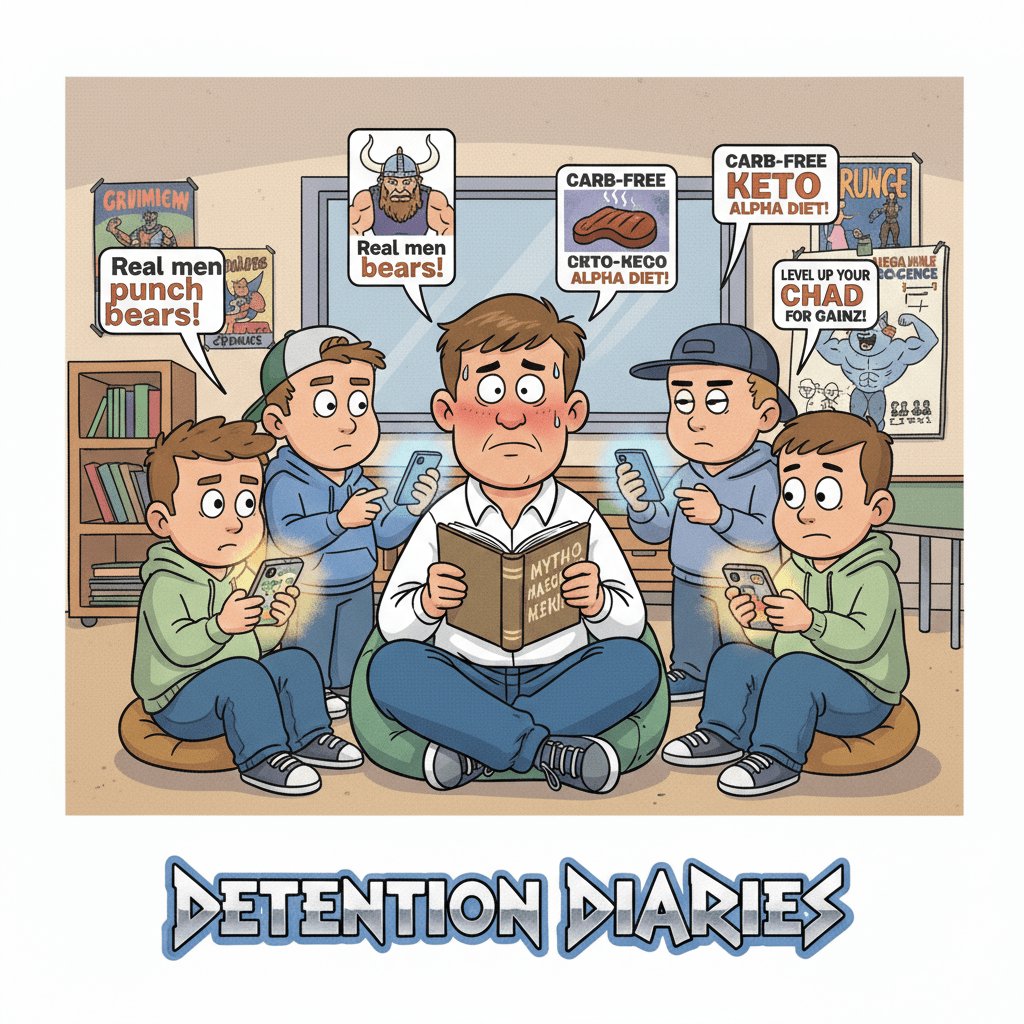
  • 🎙️ New Podcast: Progressive Masculinity, Modern Manhood & The Messy Middle

    A Conversation with Mike from Progressive Masculinity

    There are some conversations that feel important.

    Not performative.
    Not algorithm-chasing.
    Not “this will clip well for Instagram.”

    Just important.

    This week on Detention Diaries, I sat down with Mike from Progressive Masculinity to talk about something that is quietly (and sometimes loudly) shaping our classrooms, staffrooms and homes:

    What does it actually mean to be a man in 2026?

    And more importantly…
    What does it mean to be a good one?


    The Problem We’re Not Talking About Properly

    In schools, we see it every day.

    • Boys disengaging.
    • Boys underachieving.
    • Boys lashing out.
    • Boys disappearing into screens.
    • Boys struggling to articulate emotion beyond “I’m fine.”

    At the same time, there’s a cultural tug-of-war happening:

    On one side:
    “Man up.”
    “Don’t cry.”
    “Be dominant.”

    On the other:
    “Masculinity is the problem.”
    “Men need to do better.”
    “Check your privilege.”

    And somewhere in the middle?

    Confused teenage lads trying to work out who they are.

    Mike’s work with Progressive Masculinity sits in that messy middle. Not anti-men. Not anti-women. Not culture-war nonsense.

    Just thoughtful, grounded conversations about how we raise boys and support men in a healthier way.


    What We Talked About

    This wasn’t a surface-level chat. We went deep.

    We covered:

    • Why so many boys feel lost right now
    • The rise of online “masculinity influencers”
    • What schools get right (and wrong) about behaviour and identity
    • Why shame doesn’t build character
    • The difference between strength and suppression
    • How we can model better masculinity as teachers and fathers

    We also talked about vulnerability.

    Because here’s the uncomfortable truth:

    You can’t ask boys to open up if the adult men around them never do.


    Masculinity in Schools – The Reality

    As a secondary teacher, I see the tension daily.

    We want resilience.
    But we don’t want aggression.
    We want confidence.
    But not arrogance.
    We want independence.
    But we panic when they fail.

    Mike articulated something powerful:

    Boys don’t need to be “fixed.”
    They need frameworks.

    Frameworks that allow:

    • Strength with empathy
    • Discipline with reflection
    • Ambition without ego
    • Leadership without domination

    That resonated massively with me — especially in the context of behaviour conversations happening nationally.

    We’re very quick to talk about sanctions.

    We’re slower to talk about identity.


    The Role of Fathers, Teachers & Male Role Models

    We also explored something that I think a lot of men don’t say out loud:

    Many of us are figuring this out in real time.

    There was no “Progressive Masculinity Handbook” handed to our dads.
    And there wasn’t one handed to us either.

    So what do we do?

    We model curiosity.
    We model accountability.
    We model emotional literacy.
    We admit when we get it wrong.

    And we keep talking.


    🎧 Listen to the Episode

    Below you can listen to the full conversation with Mike.

    Make it Make SENDs #6: From SEND Crisis to System Reform: Lorraine Petersen OBE on What Must Change Detention Diaries

    Keywordseducation, SEND, inclusion, teacher burnout, mental health, school leadership, education reform, SEND crisis, education crisis, teacher wellbeing, child mental health, safeguarding, policy, school improvement, inclusive practiceSummaryIn this episode of Make it Make SENDs, I sit down with Lorraine Petersen OBE — former CEO of nasen, headteacher, and one of the most respected voices in SEND and inclusive education.We explore the current state of education and ask the big question: are we facing a SEND crisis… or an education system that isn’t built to support everyone?Lorraine shares her journey through education, offering deep insight into the pressures schools are facing today — from rising SEND demand and stretched resources to teacher burnout and the growing mental health needs of both staff and students.This conversation goes beyond the headlines, unpacking what’s really happening in schools right now, and more importantly, what needs to change. Lorraine speaks with clarity and honesty about how we can build a system that is more inclusive, humane, and sustainable — for both young people and the adults supporting them.If you’re a teacher, leader, SENDCO or parent trying to navigate the complexity of modern education, this episode will leave you thinking differently about what’s possible.Key Takeaways “We don’t just have a SEND crisis — we have a system that isn’t designed for everyone.”  “You cannot separate inclusion from the wellbeing of teachers.”  “If we want better outcomes for children, we must first support the adults in the system.” Support the ShowEnjoyed the episode? Then it’s time to join the class.👉 Head to http://www.detentiondiaries.com to read the blog, sign up for the newsletter, and join our online staffroom community.Because education doesn’t end at the classroom door — and neither does the conversation.Support the showEnjoyed the episode? Then it’s time to join the class. 👉 Head to http://www.detentiondiaries.com to read the blog, sign up for the newsletter, and join our online staffroom community.Because education doesn’t end at the classroom door — and neither does the conversation.
    1. Make it Make SENDs #6: From SEND Crisis to System Reform: Lorraine Petersen OBE on What Must Change
    2. Detention Diaries #6 Alun Ebeneezer – Creating a Culture of Discipline in Schools
    3. Make it Make SENDs #5 : Music and Inclusivity – is it even possible? with Kate Campbell-Green
    4. Detention Diaries #5 – Redefining Masculinity: What does it really mean to be a man?
    5. Detention Diaries #4 What Teachers Really Need: Ross McGill on Workload, Wellbeing & the Future of Schools

    Why This Conversation Matters

    If you’re a teacher — this affects your classroom.

    If you’re a school leader — this affects your culture.

    If you’re a parent — this affects your home.

    And if you’re a man trying to do better than the generation before you…

    This one’s for you.


    💬 Final Reflection

    At one point in the conversation, we laughed about how awkward these conversations can feel.

    But awkward doesn’t mean unnecessary.

    If anything, awkward usually means important.

    Mike isn’t shouting.
    He’s not selling outrage.
    He’s not building a brand off division.

    He’s doing the quieter work.

    And sometimes that’s exactly what we need.


    🙌 Support the Show

    If this episode resonated with you:

    • ⭐ Leave a review wherever you listen
    • 🔔 Subscribe to the podcast
    • 📩 Join the blog community at http://www.detentiondiaries.com
    • 📲 Share this episode with a colleague, friend or fellow parent

    The more we talk about this stuff, the less power the extremes have.

    And if you’re enjoying these conversations — your support genuinely makes a difference.


    Thanks for listening.
    Thanks for thinking.
    And thanks for being part of the Detention Diaries community.

  • Behaviour Headlines: Everyone’s Fault, No One’s Solution

    Every few months (weeks? days?), behaviour is back in the headlines like it’s just been discovered.

    Breaking news: Children are difficult.

    Cue the hot takes.

    Cue the finger-pointing.

    Cue the urgency to “fix it now”.

    If I see one more headline that starts with “Schools must…” or “Parents should…” I’m going to laminate my face and bang it against the staffroom table.

    Because here’s the uncomfortable truth:

    This didn’t break overnight.

    It’s been leaking for years.

    And instead of fixing the leak, we just kept handing out bigger buckets.

    The Great Vanishing Act

    Let’s do a quick roll call of all the things that used to catch kids before they hit crisis point:

    Youth clubs Sure Start Early intervention teams CAMHS that responded before a child was old enough to vote SEND support that didn’t involve a 14-month wait and a nervous breakdown

    Gone.

    Backlogged.

    Rebranded.

    Or quietly dissolved while everyone pretended nothing would happen.

    So now school is expected to be:

    Educator Social worker Therapist Parent Behaviour specialist Mental health service Life coach Crisis response unit

    All while being told to “do more with less”, which is management-speak for “good luck, mate”.

    Yes, Discipline Starts at Home…

    …but so does everything else.

    Of course parenting matters. Of course boundaries matter. Of course routines matter.

    But let’s not pretend we’re living in some golden age of calm, well-rested, emotionally regulated adults modelling perfect behaviour.

    We’re all knackered.

    We’re all skint.

    We’re all addicted to our screens while telling kids to get off theirs.

    We’re all terrified of short-term discomfort.

    Because short-term discomfort feels bad.

    Long-term consequences feel… theoretical.

    So it’s easier to say:

    “Just let them have the iPad” “I can’t deal with this tonight” “They’ll grow out of it” “School will sort it”

    (Plot twist: school did not sort it.)

    Screens, Status and Silent Pressure

    Kids today aren’t just navigating adolescence.

    They’re navigating:

    Constant comparison Unrealistic standards Algorithms designed to keep them hooked A world where looking successful matters more than being stable

    And in communities like mine, there’s something even heavier:

    A real lack of visible ambition.

    Not because kids don’t care.

    But because they look around and think:

    “What’s the point?”

    They see adults working themselves into the ground for not much back.

    They see prices rising faster than wages.

    They see robots, AI and algorithms doing jobs better than humans.

    Why graft for exams when:

    AI writes the essay Robots take the job Mum and Dad are still struggling anyway

    Honestly… from their perspective?

    It’s not even irrational.

    The Parent–Teacher Punch-Up Nobody Wins

    And now comes my favourite bit:

    The media poking the hornet’s nest.

    “Is it lazy parenting?”

    “Have parents lost control?”

    “Teachers say behaviour is out of hand.”

    This is the moment where everyone is invited to fight.

    Teachers are nudged to say:

    “Yes, parents are the problem.”

    Parents are nudged to respond with:

    “School traumatised me and you’re useless.”

    Students sit back with popcorn watching the adults implode.

    Meanwhile, nothing improves.

    Because while we’re arguing about who’s to blame, the system keeps failing the same kids.

    Again.

    And again.

    And again.

    The Bit That Actually Scares Me

    What scares me isn’t poor behaviour.

    Kids have always pushed boundaries.

    What scares me is:

    How normalised chaos has become How numb everyone feels How quickly we jump to punishment instead of prevention How isolated parents and teachers both feel

    We’re tired.

    We’re defensive.

    We’re all being asked to carry more than we were built to hold.

    And instead of fixing the foundations, we’re arguing about wallpaper.

    So… What Now?

    I don’t have a neat solution.

    Anyone who says they do is selling something.

    But I do know this:

    This isn’t a “school problem” It isn’t a “parent problem” It isn’t a “kid problem”

    It’s a society problem that’s been ignored for so long we’re shocked it’s finally boiling over.

    If we keep shouting across the divide, everyone loses.

    Especially the kids who already feel like the system gave up on them.

    And that?

    That’s the scariest bit of all.

    Scary shit, honestly

  • Can We Just… Support the Schools Please?

    There was a time when the phrase
    “You’ll hear about this when you get home”
    struck fear into the heart of a child.

    Now it’s more like:
    “My mum will email SLT.”

    And honestly? That might be the single most impressive behavioural U-turn in British history.

    Ask Not What Your School Can Do for You…

    …but what you can do for your school.

    Yes, I’ve gone full JFK. Strap in.

    Because schools are currently expected to:

    • Raise your child
    • Educate your child
    • Regulate your child’s emotions
    • Undo the damage caused by TikTok, YouTube, WhatsApp, Fortnite, Instagram and whatever fresh hell has dropped this week
    • Provide therapy
    • Teach morals
    • Provide structure
    • Offer unlimited grace
    • Never shout
    • Never sanction
    • Never exclude
    • Never offend
    • Never inconvenience

    All while being told they are failing your child if the school dares to say:

    “Actually… no. That behaviour isn’t acceptable.”

    Meanwhile, Back in Reality…

    I have recently spoken to teachers who:

    • Have been assaulted by pupils
    • Feel physically unsafe at work
    • Are on edge daily
    • Are considering leaving the profession not because of workload — but because of fear

    Let that sink in.

    Not stress.
    Not marking.
    Not Ofsted.

    Fear.

    And this is no longer rare. It’s becoming disturbingly normal.

    When Did This Become OK?

    At what point did society collectively decide:

    • Spitting at staff is a communication issue
    • Throwing furniture is a regulation difficulty
    • Swearing at adults is self-expression
    • Violence is a failure of the school to build relationships

    Public services are feeling this everywhere:

    • NHS staff assaulted
    • Retail workers abused
    • Police officers undermined
    • Teachers… gaslit

    And education has somehow become the place where everything is negotiable — except the wellbeing of the people actually doing the job.

    The Parent Entitlement Olympics 🏅

    Somewhere along the way, support turned into surveillance.

    We now live in a world where:

    • Every sanction is interrogated like a murder trial
    • Every detention requires a written defence
    • Every behaviour conversation ends with
      “That’s not what he’s like at home.”

    Congratulations.
    He’s not at home.

    Schools are not customer service centres.
    Teachers are not punchbags.
    Education is not Amazon Prime.

    Let’s Be Clear (Before Someone Emails Me)

    This is not anti-parent.
    This is not anti-child.
    This is not anti-SEND.
    This is not “bring back the cane” (calm down, Daily Mail).

    This is pro-common sense.

    Children need:

    • Boundaries
    • Consistency
    • Adults who are backed
    • Consequences that mean something

    And teachers need:

    • Support
    • Trust
    • Safety
    • The right to say no without being crucified

    What Can Parents Actually Do?

    Glad you asked.

    • Believe schools aren’t out to get your child
    • Reinforce boundaries at home
    • Back sanctions even when it’s uncomfortable
    • Model respect for authority
    • Stop excusing behaviour that would get you arrested at Tesco

    And maybe — just maybe — ask your child:

    “What you could have done differently?”

    Wild concept. Revolutionary.

    Final Thought (Before I Get Reported)

    Schools cannot fix society alone.

    If schools collapse, everything else follows.
    If teachers leave, nobody wins.
    If fear becomes normalised, we’ve already lost.

    So yes — please, can we just support the schools?

    Because the alternative is unthinkable.

    And frankly…
    we’re closer to it than anyone seems willing to admit.

    Or, maybe We Just Fund Self-Defence Classes for Teachers?

    At this point, can we stop pretending and just be honest?

    Forget CPD on “Effective Use of Questioning in Mixed Ability Groups”
    what teachers actually need is:

    • Level 1: Dodging Chairs (KS3 Edition)
    • Level 2: De-escalation or Judo Roll? You Decide
    • Level 3: Blocking a Vape While Calling SLT

    INSET Day Agenda:

    • 9:00–10:30 → Safeguarding Update
    • 10:30–10:45 → Biscuits
    • 10:45–12:00 → Krav Maga (Behaviour Hotspots Focus)

    We could rebrand it:

    “Trauma-Informed Tactical Awareness (with Light Stretching)”

    Fully funded, obviously.
    Because if we can find money for:

    • Laminated posters
    • Consultancy packages
    • Six different behaviour tracking systems
    • A visiting speaker who once taught for 18 months in 2004

    Surely we can stretch to:

    • Basic self-defence
    • Protective gloves
    • A panic button that actually works

    Maybe throw in a school-branded mouthguard:

    “Excellence Through Resilience™”

    Satire Aside (Unfortunately)

    The joke lands because it’s too close to the truth.

    Teachers should not need:

    • Defensive stances
    • Escape techniques
    • Incident logs that read like crime reports

    Yet here we are — laughing about it, because if we don’t, we’ll scream.

  • New Podcast : From Teacher to Thought-Leader: A Conversation with Ross McGill

    Every so often, you get to sit down with someone who doesn’t just talk about education — they’ve lived it, questioned it, survived it, and then tried to make it better for everyone else.

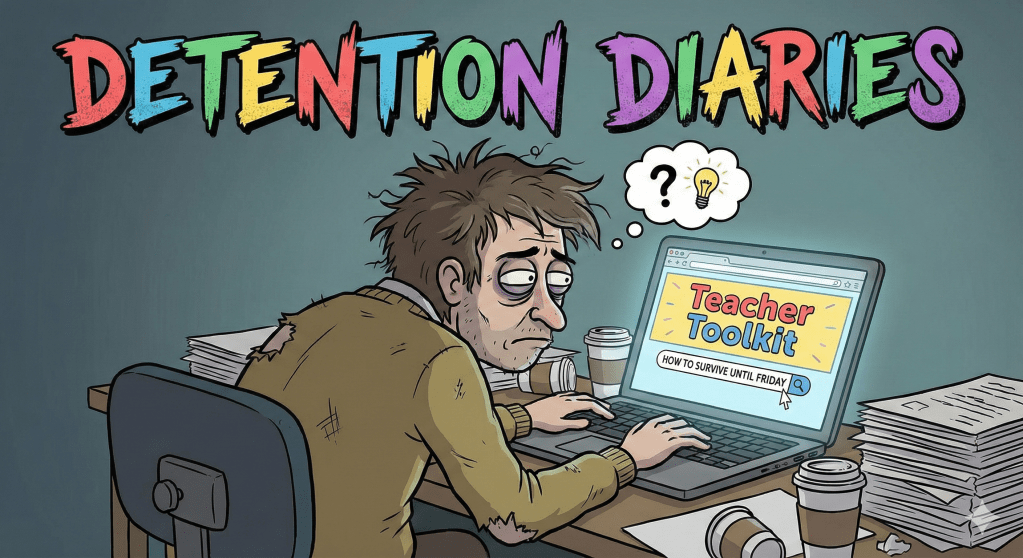
    This week on Detention Diaries, I had the pleasure of speaking with Ross McGill, the founder of Teacher Toolkit — a platform most teachers will have stumbled across at some point during a late-night Google spiral that started with “how do I survive teaching?” and ended with “ah… it’s not just me then.”

    Why this conversation matters

    Ross’s journey mirrors that of so many teachers across the UK: passionate beginnings, relentless workload, the emotional toll of the job, and that growing realisation that the system doesn’t always support the people holding it together.

    In this conversation, we don’t shy away from the big stuff:

    • Teacher workload and burnout
    • The wellbeing crisis in education
    • What actually helps teachers (and what definitely doesn’t)
    • Why schools need honesty, not just another initiative
    • How Teacher Toolkit became a space teachers genuinely trust

    It’s not a sales pitch. It’s not buzzwords. It’s one teacher talking to another about the reality of the job — the bits we rarely get time to say out loud.

    Teaching, but human

    One of the things I really valued about this episode was Ross’s openness. There’s no pretending teaching is “fine if you just manage your time better.” There’s an acknowledgment that education is complex, emotional, and often exhausting — and that supporting teachers properly isn’t a luxury, it’s essential.

    That honesty is exactly why Teacher Toolkit resonates with so many educators. It doesn’t talk at teachers — it talks with them.

    🎧 Listen to the episode

    👉 Podcast link:

    Make it Make SENDs #6: From SEND Crisis to System Reform: Lorraine Petersen OBE on What Must Change Detention Diaries

    Keywordseducation, SEND, inclusion, teacher burnout, mental health, school leadership, education reform, SEND crisis, education crisis, teacher wellbeing, child mental health, safeguarding, policy, school improvement, inclusive practiceSummaryIn this episode of Make it Make SENDs, I sit down with Lorraine Petersen OBE — former CEO of nasen, headteacher, and one of the most respected voices in SEND and inclusive education.We explore the current state of education and ask the big question: are we facing a SEND crisis… or an education system that isn’t built to support everyone?Lorraine shares her journey through education, offering deep insight into the pressures schools are facing today — from rising SEND demand and stretched resources to teacher burnout and the growing mental health needs of both staff and students.This conversation goes beyond the headlines, unpacking what’s really happening in schools right now, and more importantly, what needs to change. Lorraine speaks with clarity and honesty about how we can build a system that is more inclusive, humane, and sustainable — for both young people and the adults supporting them.If you’re a teacher, leader, SENDCO or parent trying to navigate the complexity of modern education, this episode will leave you thinking differently about what’s possible.Key Takeaways “We don’t just have a SEND crisis — we have a system that isn’t designed for everyone.”  “You cannot separate inclusion from the wellbeing of teachers.”  “If we want better outcomes for children, we must first support the adults in the system.” Support the ShowEnjoyed the episode? Then it’s time to join the class.👉 Head to http://www.detentiondiaries.com to read the blog, sign up for the newsletter, and join our online staffroom community.Because education doesn’t end at the classroom door — and neither does the conversation.Support the showEnjoyed the episode? Then it’s time to join the class. 👉 Head to http://www.detentiondiaries.com to read the blog, sign up for the newsletter, and join our online staffroom community.Because education doesn’t end at the classroom door — and neither does the conversation.
    1. Make it Make SENDs #6: From SEND Crisis to System Reform: Lorraine Petersen OBE on What Must Change
    2. Detention Diaries #6 Alun Ebeneezer – Creating a Culture of Discipline in Schools
    3. Make it Make SENDs #5 : Music and Inclusivity – is it even possible? with Kate Campbell-Green
    4. Detention Diaries #5 – Redefining Masculinity: What does it really mean to be a man?
    5. Detention Diaries #4 What Teachers Really Need: Ross McGill on Workload, Wellbeing & the Future of Schools

    Whether you’re a classroom teacher, middle leader, senior leader, or someone who’s stepped away from teaching but still cares deeply about education — this one’s for you.

    🔗 Find Ross & his work

    Join the Detention Diaries community

    If this episode resonates — and I suspect it will — don’t just listen and move on.

    👉 Subscribe to the Detention Diaries podcast so you don’t miss future conversations with teachers, leaders, and education voices who actually get it.
    👉 Join the community at www.detentiondiaries.com for blogs, podcasts, videos, and the occasional therapeutic rant about life in education.

    Because teaching is hard enough. We might as well talk about it — honestly.

Detention Diaries

Exploring Education, building a community

Skip to content ↓