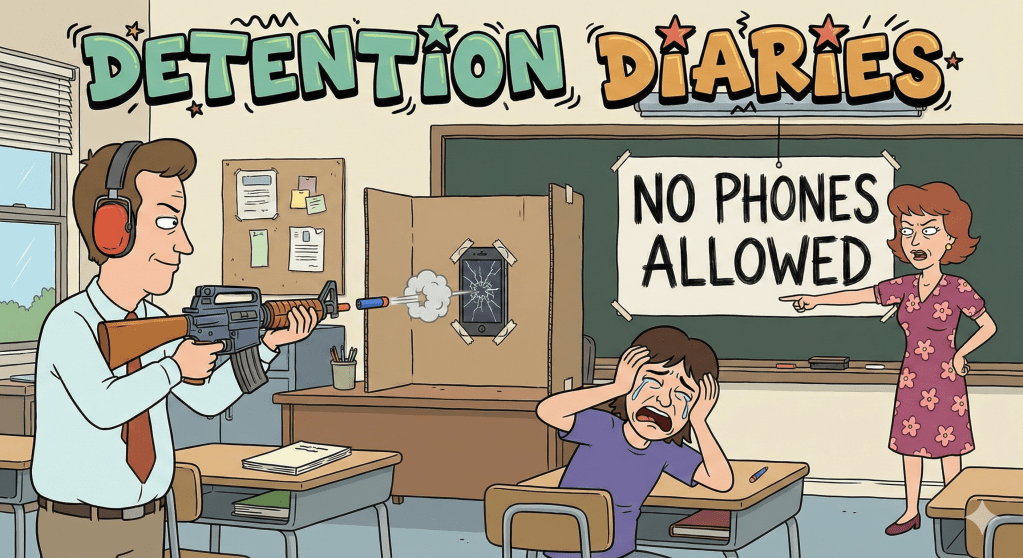
• Ban the Phones, Save the Children (Apparently)

    So here we are again.
    Another headline.
    Another moral panic.
    Another attempt to fix a deeply complicated problem with a blanket ban.

    This time, it’s phones.

    Now — before anyone starts sharpening pitchforks — let me say this clearly:
    Young people are in an attention crisis.
    That part isn’t up for debate.

    But I can’t shake the feeling that once again, we’re demonising technology in a world where technology is not just around us — it is us.

    And banning it outright feels a bit like banning spoons because some people eat too fast.


    I Was the “Tech One” in the Family

    I’ve always been the one who gets shouted downstairs to fix the TV.

    “Why’s Netflix gone?”
    “The Wi-Fi’s broken.”
    “The remote’s not working.”
    “The screen’s gone funny.”

    I don’t actually know more than anyone else — I just grew up pressing buttons until things worked.

    And I like that role.
    It gives me a sense of purpose.
    Especially when I’m not particularly good at much else.

    I grew up with technology.

    Not the sleek, shiny version we have now — but the grindy, noisy, temperamental stuff.

    I came of age just after:

    • The dotcom bubble
    • The Millennium Bug
    • All the tinfoil-hat predictions that civilisation would end at midnight

    I lived through:

    • Dial-up internet
    • File sharing (Kazaa — still the greatest thing the internet ever produced)
    • Game Boys
    • Consoles
    • Online gaming before it was socially acceptable

    And somehow…
    My eyes didn’t turn square.
    Robots didn’t take over.
    And my brain hasn’t fully rotted despite years of shoot-’em-ups.


    But It Was Different. And We Know It Was.

    Here’s where the argument gets interesting.

    When we grew up:

    • Social media was MySpace
    • Messaging was MSN (shout out to the MSN Messenger crew)
    • Videos didn’t autoplay
    • Algorithms didn’t exist
    • And it took 34 minutes for a grainy picture of Russian tennis players to load

    There were no short-form videos engineered to hijack your attention.
    No infinite scroll.
    No dopamine slot machine in your pocket.

    You had time to get bored.
    And boredom did something useful.

    Today?
    You can sit on your sofa and:

    • Order food
    • Message strangers
    • Watch endless clips
    • Doomscroll yourself into oblivion

    All without standing up.

    So yes — it’s no wonder we have an attention crisis.


    So Where Do Phones Fit In?

    This is the bit no one seems comfortable talking about.

    Because it’s easier to say “ban them” than admit this is complicated.

    Phones are:

    • A safeguarding issue
    • A distraction
    • A social minefield

    But they’re also:

    • Tools
    • Lifelines
    • How the modern world works

    We survived and thrived with technology.
    So the question isn’t “Can young people handle it?”

    It’s:
    Have we taught them how?

    Or have we just handed them the keys and then acted shocked when they crashed?


    A Ban From Whitehall Should Ring Alarm Bells

    Here’s where I get uneasy.

    A blanket ban on phones coming from Whitehall feels… off.

    Who are we to decide that young people shouldn’t have access to the tools that define their world?

    Especially when:

    • Adults use phones constantly
    • Schools increasingly rely on technology
    • Society expects digital fluency

    Could phones be a force for good?
    Could they be used responsibly?
    Could we teach boundaries, ethics, balance?

    Or have we reached the point where social media and instant messaging are so deeply embedded in young people’s psyche that it genuinely needs to be ripped out — cold turkey?

    I don’t know.

    And anyone who says they definitely know is lying.


    The Magical Thinking Bit

    Of course, there’s a part of this debate that’s… aspirational.

    Maybe banning phones will:

    • Fix behaviour
    • Improve attendance
    • Sort punctuality
    • Re-engage parents
    • Reduce teacher workload
    • Restore order
    • Heal society

    Maybe.

    But it also feels suspiciously like we’re pinning a lot on one small rectangle of glass.

    Phones didn’t cause every problem in education.
    They just made the cracks more visible.


    Final Thought

    This isn’t a defence of phones.
    And it’s not a rejection of boundaries.

    It’s a plea for nuance.

    Technology isn’t going away.
    Young people aren’t going back.
    And banning things without teaching replacement skills rarely works.

    Maybe the answer isn’t ban or no ban.

    Maybe the answer is:

    • Education
    • Digital literacy
    • Modelling balance
    • And accepting that this is messy

    I could be wrong.

    Maybe banning phones will fix everything.

    But if it does…
    I’ll eat my Game Boy.
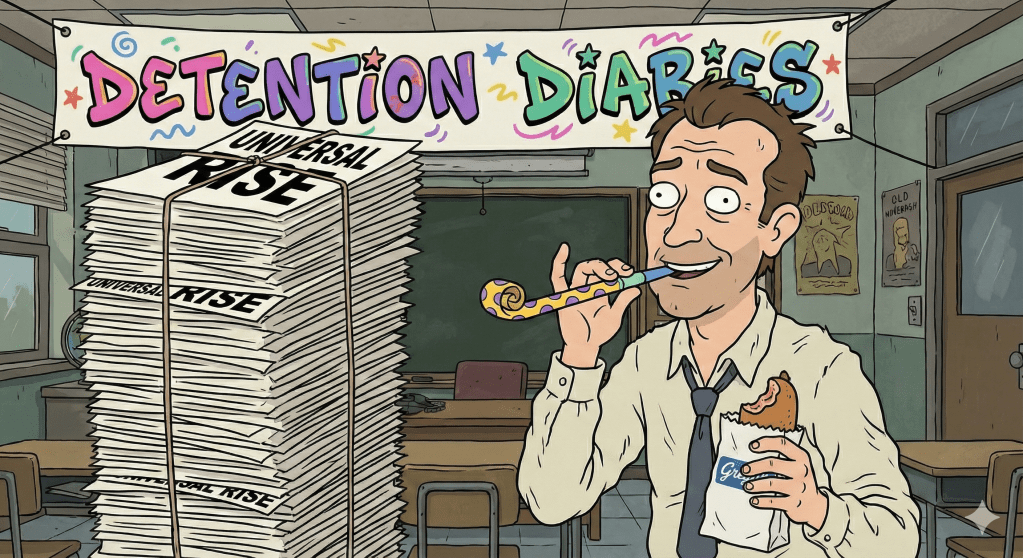
  • RISE and Shine (Apparently): Or How to Spend £1.5m on Pedagogical Flatulence

    I’ll be honest — I’m a bit flabbergasted.

    Not shocked.
    Not surprised.
    Just that very specific educational emotion where you stare into the middle distance and think, “Have we learned absolutely nothing?”

    Enter RISE.

    Our Bridget — Bridget Phillipson — has explained that:

    “The universal RISE programme is being promoted as an optional offer available to all schools. Targeted RISE, on the other hand, involves direct intervention in schools judged to need significant improvement.”

    Now… call me cynical, but that second bit sounds remarkably familiar.

    You know.
    Judgements.
    Labels.
    Categories.
    The same pressure cooker that led to a school leader taking their own life.

    But sure — let’s crack on like that never happened.


    Judgement, But Softer. Probably.

    We are knee-deep in a new Ofsted framework.

    Schools are spinning.
    Leaders are chasing their tails.
    Staff are trying to decode guidance documents written in that special brand of bureaucratic English that means everything and nothing at the same time.

    And just as everyone’s about to collapse into a puddle of laminated policies…

    Surprise!
    Here’s another thing to think about.

    Another initiative.
    Another acronym.
    Another “supportive offer” that still hinges on judgement.

    Because at the heart of all of this — despite the rebrand, the softer language, the pastel colour scheme — we’re still being reduced to a few words.

    Words that attempt to summarise a complex, nuanced, un-generalisable place called a school.

    It’s like reviewing a Michelin-star restaurant by saying:

    “Food happened.”


    Optional… But Meaningless

    Here’s my favourite bit:

    “It is understood that the DfE does not expect schools to engage with universal RISE and will not follow up with those that choose not to take part.”

    Right.

    So let me get this straight.

    • It’s optional
    • No one will check
    • No one will follow up
    • No one will measure engagement

    Which begs the obvious question:

    What’s the fucking point?

    That’s not an improvement strategy.
    That’s a suggestion box with vibes.


    All Fart, No Shit

    And then this absolute gem:

    “The DfE also said that it will not be able to fully quantify how many schools are engaging with universal RISE, particularly where support takes place informally between schools and trusts through local networks.”

    Ah yes.
    The classic “trust us, it’s happening somewhere” approach.

    All fart.
    No shit.

    Nothing says robust national improvement strategy like “we assume some people are having chats.”


    £1.5 Million Well Spent (LOL)

    Now for the headline number:

    “The DfE has committed around £1.5m this financial year to support universal RISE activity across the country.”

    Amazing.

    That works out at roughly £2.44 per teacher.

    £2.44.

    What can we do with that?

    • Half a coffee
    • A packet of Smarties
    • Or — and hear me out — a Greggs sausage roll

    Which honestly might be the most effective professional development many of us get all year.

    Maybe that’s the vision.

    We all sit around with a lukewarm sausage roll, talking about pedagogy, knowing full well:

    • No one will check
    • No one will record it
    • No one will evaluate it
    • And no one will care

    But it sounds supportive.

    RISE, indeed.


    The Bigger Problem

    The most frustrating part isn’t even RISE itself.

    It’s the opportunity cost.

    Because £1.5m — while laughable at scale — could still be used for things that actually matter, like:

    • Proper SEND support
    • Mental health provision
    • Reduced workload
    • Funded release time
    • Specialist training that lasts longer than an afternoon

    Instead, we get a half-baked “improvement opportunity” that exists mostly on paper.

    A policy designed to be seen, not felt.


    Final Thought

    RISE feels like education policy by PowerPoint.

    Well-intentioned.
    Softly worded.
    Entirely disconnected from reality.

    If we’re serious about improvement, then we need:

    • Investment, not initiatives
    • Trust, not judgement in disguise
    • Support that actually lands in classrooms

    Until then, I’ll be at Greggs, sausage roll in hand, rising absolutely nowhere.

    But at least it’s warm.

  • Mr Holloway, Episode Three: Thirsty Thursdays

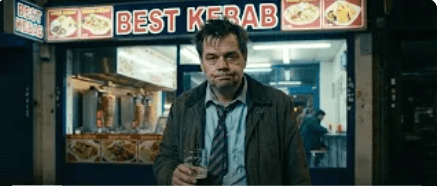
    This week sees the release of the third documentary-style vlog following secondary school teacher Mr Gareth Holloway.

    In previous episodes, we observed Gareth navigating the routines of school life — lessons, expectations, meetings, and the slow accumulation of pressure that comes with the job. Episode three shifts the focus beyond the school gates.

    Filmed over the course of a Thursday evening, this instalment follows Gareth during an ongoing performance improvement plan. Outstanding marking remains unfinished. Professional targets remain unmet. The working day ends — but the weight of it does not.

    Rather than continuing with school-related tasks, Gareth spends the evening in town. The film documents what happens next without commentary, interviews, or explanation. The camera simply stays with him.

    This episode is quieter than the previous two. There is no clear narrative arc, no resolution, and no message spelled out for the viewer. Instead, it presents a familiar pattern: fatigue, avoidance, routine, and brief moments of relief.

    It is not a film about rebellion.
    It is not a film about failure.

    It is a record of how one teacher spends an evening when the pressure does not switch off.

    You can watch Episode Three of the Mr Holloway documentary series here:


    👉 https://youtu.be/jYd3ND2tm2Q

    As always, Detention Diaries exists to document the realities of education as they are lived, not as they are described in policies or presentations. If this episode feels familiar, that is not accidental.

    More to follow.

  • To the ITTs Heading Into Placement B: You Absolute Legends

    If you’re reading this and you’ve just finished Placement A of your PGCE, take a moment.

    A real one.

    Because learning to teach is fucking hard — and you’ve just survived the first half of it.

    There are very few jobs where “training” involves standing in a room with 30 other people’s children, trying to stop them from killing each other, while simultaneously being convinced that they want to kill you.

    All while being observed.
    Assessed.
    Graded.
    And politely told you should “project your voice more.”

    And yet — here you are.


    Placement A Wasn’t Just Hard. It Was Character Building. (In a Bad Way.)

    Placement A is grim because it’s your first exposure to the reality of teaching.

    It’s where you learn that:

    • Lesson plans rarely survive contact with students
    • Behaviour management is not something you “pick up naturally”
    • You will replay entire lessons in your head at 3am
    • And confidence is mostly pretending until something sticks

    You’ve stood in front of classes with sweaty palms and a racing heart, trying to remember your learning objective while someone at the back asks if they can “just go toilet, miss, I’m actually dying.”

    You’ve done break duty.
    You’ve been stared at.
    You’ve been tested.
    You’ve questioned your life choices.

    That alone deserves respect.


    If Placement A Didn’t Go to Plan — That’s OK Too

    This bit matters.

    If you didn’t pass Placement A — you are not a failure.

    Read that again.

    Teaching is not linear.
    Confidence doesn’t arrive on schedule.
    And some people need more time, support, or the right environment to thrive.

    Use this moment properly:

    • Reflect honestly
    • Ask uncomfortable questions
    • Identify what didn’t work
    • Come back stronger

    Some of the best teachers I know stumbled early.
    What matters is whether you learn from it — not whether everything went smoothly the first time.


    Placement B: You’re Not Starting From Scratch Anymore

    Here’s the good news.

    You’re not going into Placement B as a complete beginner.

    You now:

    • Know how a school actually functions
    • Understand classroom dynamics
    • Have felt what it’s like to be in it
    • Know your weaknesses — and that’s powerful

    You’ll still have wobbles.
    You’ll still have lessons that implode.
    But you’ll also start to notice moments where things just… work.

    Those moments matter.
    They mean you’re becoming a teacher.


    The Unsung Heroes of Schools

    Let’s say this loudly:

    Teacher trainees are the unsung heroes of schools.

    You’re often:

    • Used as extra hands
    • Given the “can you just…?” jobs
    • Asked to cover, support, help, and adapt
    • Doing the emotional labour of learning while performing

    But here’s the thing — you don’t just teach young people.

    You teach us, too.

    Experienced teachers learn from trainees all the time:

    • New ideas
    • Fresh perspectives
    • Updated pedagogy
    • Actual enthusiasm (which is unsettling but welcome)

    You remind us why we started.

    And that matters more than you realise.


    Final Word and a few moments of reflection

    So if you’re heading into Placement B feeling:

    • Nervous
    • Excited
    • Terrified
    • Proud
    • Or all of the above

    Good.

    That means you care.

    Teaching isn’t easy.
    Training to teach is harder.
    And you are doing something genuinely brave.

    Big up the PGCEs.
    You’re not just surviving — you’re becoming.

    And that’s something to be proud of.

    Now… have a think – ask yourself some questions:

    What Have I Actually Learned So Far?

    1. What do I understand now about teaching that I didn’t understand before Placement A?
    2. Which skills have improved the most — even if they’re still messy?
    3. What has surprised me most about myself in the classroom?
    4. When did I feel most like a “real” teacher, even briefly?
    5. What mistakes taught me the biggest lessons?

    How Am I Really Feeling About Teaching Right Now?

    1. What emotions come up when I think about starting Placement B?
    2. What moments from Placement A still sit with me — good or bad?
    3. What situations cause me the most anxiety, and why?
    4. When did I feel proud of myself, even if no one else noticed?
    5. What do I need more support with this time around?

    What Do I Want to Get Out of Placement B?

    1. What would “progress” look like for me by the end of this placement?
    2. Which areas do I want to actively work on (behaviour, confidence, planning, relationships)?
    3. What kind of feedback do I want to seek out — and from who?
    4. What risks am I willing to take to improve (trying new strategies, asking for help)?
    5. How do I want students to experience me as their teacher?

    What Do I Want From My Teaching Career?

    1. What kind of teacher do I want to be remembered as?
    2. What values matter most to me in education?
    3. What parts of teaching give me energy — and what drains it?
    4. How do I want teaching to fit into my wider life, not consume it?
    5. In five years, what would make me say, “I’m glad I stuck with this”?

    Leave a comment

  • “You Get All Them Holidays Though” — And Other Things Said Before a Teacher Loses the Will to Live

    This one is a bit different, I’ve been helping a trainee these last few weeks and it has reminded me just how difficult it is for all of us.


    I’ve also been reading a lot about the new £200m pot for teacher training in SEND. Nice one!

    Let’s start at the beginning.

    The PGCE.

    Also known as:

    • The Hunger Games, but with lesson plans
    • A year-long audition where no one tells you the rules
    • Being thrown into a classroom with 30 children and a smile that says “you’ll be fine”

    PGCE training is brutal.
    Not “challenging.”
    Not “intense.”

    Brutal.

    You are expected to:

    • Learn how to teach
    • Learn how to manage behaviour
    • Learn safeguarding
    • Learn SEND
    • Learn assessment
    • Learn how to not cry in the cupboard

    All while being observed, graded, judged, and occasionally told you should “try smiling more.”

    Then — just as you start to feel vaguely competent — they hand you a timetable, pat you on the back, and release you into the wild.

    No safety briefing.
    No survival kit.
    Just vibes and a whiteboard marker that doesn’t work.


    Thrown to the Lions (With a Seating Plan)

    From day one, you are expected to be:

    • An outstanding teacher
    • A data analyst
    • A SEND specialist
    • A therapist
    • A mediator
    • An attendance officer – what are you doing about attendance?
    • A safeguarding expert
    • A provider of snacks, pencils, emotional reassurance, and occasionally deodorant

    Parents want results.
    The public want miracles.
    Students want snacks and for you to “chill.”

    And heaven forbid you don’t immediately master all of it.

    Because someone — usually someone who hasn’t set foot in a school since 1994 — will say:

    “Teaching can’t be that hard.” or sometimes… “What, secondary? I don’t know how you do it!”


    Ah Yes… The Holidays

    And then it comes.

    The sentence.

    The one that makes every teacher’s eye twitch.

    “Well… you do get all them holidays.”

    ALL.
    THEM.
    HOLIDAYS.

    Said casually.
    With confidence.
    Like it’s a mic drop.

    At which point, something ancient and feral awakens inside us.

    Because yes — we get school holidays.
    Which are:

    • Unpaid for many
    • Spent recovering like Victorian convalescents
    • Filled with planning, marking, prep, and anxiety
    • Or lying face down wondering what year it is

    But say one bad word about our holidays and suddenly every teacher within a five-mile radius is activated.

    We will smile politely on the outside while mentally drafting a PowerPoint titled:

    “No, Sharon, I never fucking switch off and some idiot is always emailing me during half term anyway.”

    Our holidays are sacred.
    Mention them incorrectly and you’ll see things you can’t unsee.


    SEND Training: A Drop in the Ocean

    Which brings us neatly to the latest proposal — funding for SEND training for all teachers.

    On paper?
    Brilliant.

    In reality?
    It feels a bit like saying:

    “Right, we’ve noticed you’re drowning… here’s a leaflet.”

    SEND training matters. Massively.
    But one-off sessions, surface-level CPD, and buzzwords are not going to turn teachers into educational psychologists overnight.

    You don’t become:

    • A SEND lead
    • An ED psych
    • A trauma specialist

    Because someone put you in a hall for two hours with a PowerPoint and a biscuit.

    We need proper, ongoing, expert-led training — not something designed to tick a box and look good in a policy document. Which is why £200m is not even a drop in the ocean – there are half a million teachers across the country requiring more (because we want it done properly, not because we’re incapable) than just a poster.

    Funnily enough I can see it now, just like the huge issue about sexual harassment. “Stick a poster up about it not being ‘banter’ that’ll show ’em!”

    This can’t be the same SEND is a real issue across the country, I should know – my daughter is autistic. She gets unbelievable support at her mainstream school but they go above and beyond. They do all this with their own purse strings!


    Final Thought

    Teaching asks you to be everything, all at once, with minimal training and maximum judgement.

    You are trained intensely…
    Then launched violently…
    Then criticised constantly…
    Then reminded you’re “lucky” because of the holidays.

    And still — somehow — you show up.

    So next time someone says:

    “At least you get all them holidays…”

    Smile.
    Breathe.
    And remember:
    They couldn’t last a week on a PGCE.

    And they definitely couldn’t survive Monday period one.

  • “Do I Just Sound Like Victor Meldrew Now?”

    I used to get the kids.

    I used to feel that magical teacher-student connection where you could read the room, laugh at the jokes, understand the references, and genuinely feel like you were part of their world.

    Now?
    I’m pretty sure they live in some kind of alternate TikTok dimension that runs on likes, filters, and audio bites about how to survive a zombie pandemic involving a pineapple pizza.

    Meanwhile, I’m sat there thinking:

    “Back in my day, reality had a face… and we called it the weather.”

    At what point did the young people I teach become fluent in 18 different social platforms but completely mute in anything resembling eye contact?

    At what point did their idea of “deep connection” become:

    “Why did you steal my pen? I logged it as a trauma.”

    Is it me?
    Am I just getting old and grumpy like Victor Meldrew?
    Honest question.
    The fact I know who Victor Meldrew is probably says everything about how uncool I am. (And I proudly embrace that.)

    But sometimes I watch my classes and think:

    Are they actually living in real life…
    or is this just a very immersive social media simulation?

    They’ll reply to an AI-generated meme instantly.
    They’ll tap their screen with surgical precision…
    But mention something actual — like “the weather”, “your emotions”, or “why you haven’t done your homework” — and suddenly they’ve got a buffering icon above their head.

    It’s like they were born with a Snapchat filter permanently attached.

    I’ll ask a question, and they don’t look at me — they look past me, as if my words are a background app they haven’t closed properly.

    And the worst part?

    They don’t even apologise.

    When I was a kid, ignoring someone involved actual effort.
    You had to look away.
    Pretend you didn’t hear.
    Engage in subterfuge.

    Now?
    It’s just mute mode.
    The ultimate passive-aggressive war tactic.

    So am I just old?
    Am I Victor Meldrew in a cardigan, grumbling about “kids these days”?

    Maybe.

    But also, maybe the kids are living in a warped digital alternate reality where:

    • The world makes sense only through a smartphone screen
    • Eye contact is optional
    • And attention spans have the lifespan of a fruit fly

    Either way — it’s a culture clash.

    One day someone will ask me what TikTok even is, and I’ll tell them:

    “Back in my day, we had TIC TACs — and they were minty fresh.”

    And that, my friends, is when you know you’re officially uncool.

  • Back to School: The Fear Is Real (But So Are You)

    Well.

    It’s happening.

    Netflix is giving you that “Are you sure?” look.

    The booze has to go back in the cupboard.

    You’re brushing your teeth like a Victorian chimney sweep because no child needs to smell Baileys and regret on a Tuesday morning.

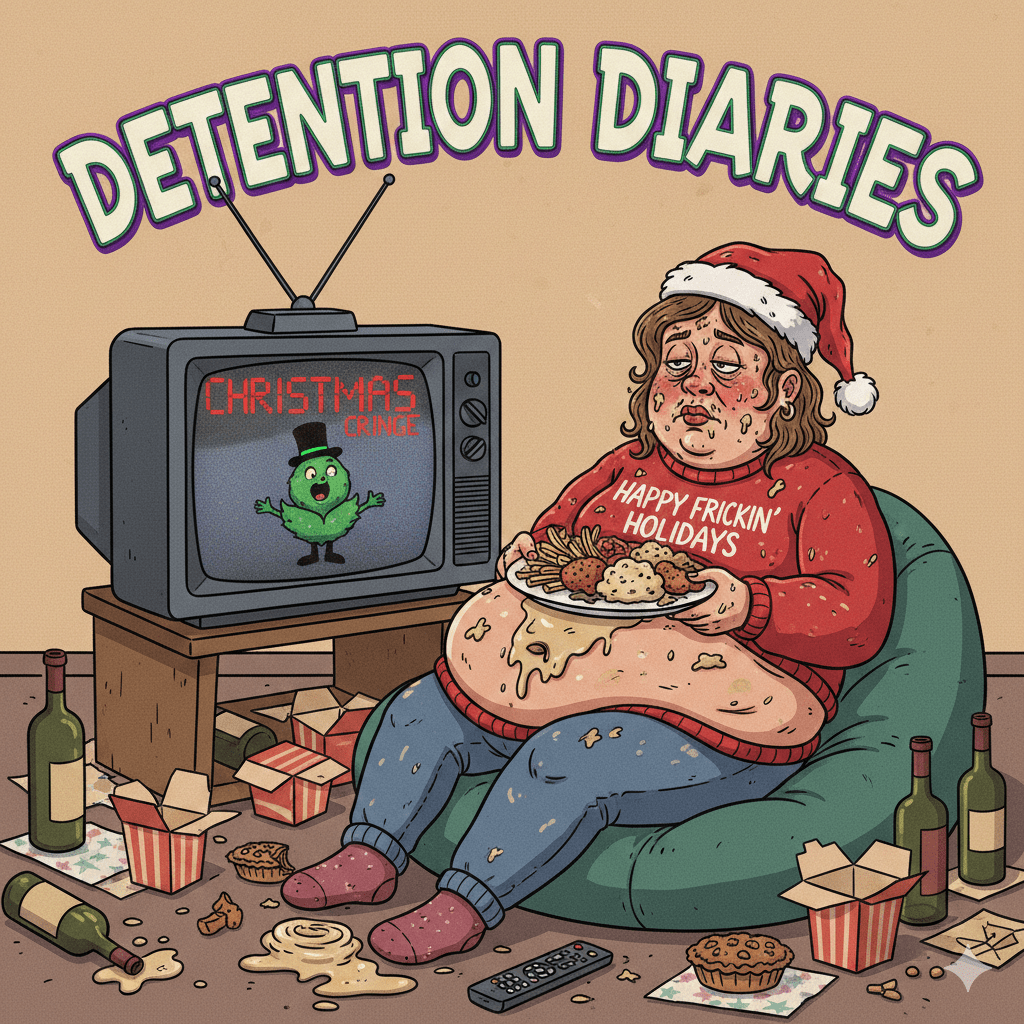
    The fairy lights are coming down (if they’re not already a permanent feature of your personality), and it’s time to roll your festive, beige-food-loving body off the sofa and back into school.

    Deep breaths.

    This is normal.

    This dread is universal.

    You Survived the Worst Term of the Year

    Let’s get one thing straight:

    Autumn term is feral.

    It’s long.

    It’s dark.

    Everyone’s ill.

    Behaviour goes sideways by mid-November.

    And December is just vibes and damage control.

    And yet…

    You survived it.

    You dragged yourself through the world’s most awful term and somehow emerged alive, mostly intact, and with only minor emotional scarring. That means — incredibly — you can do it again.

    Welcome to spring term.

    Yes, it’s still absolutely fucking freezing.

    Yes, it’s dark in the morning and dark again by 3:47pm.

    But it does get better. Slowly. Eventually. Allegedly.

    If You’re Primary: They’re Genuinely Buzzing to See You

    Primary teachers — brace yourselves.

    Your kids will come back like golden retrievers who haven’t seen you in two weeks:

    Huggy Loud Slightly feral Desperate to tell you everything they did over Christmas

    The good news?

    All those routines you drilled into them last term are still in there. Beneath the chaos. Beneath the glitter glue. They’ll remember how school works quicker than you think.

    They’re ready.

    They’re excited.

    And honestly? They’re probably just happy to see a safe adult who isn’t related to them.

    If You’re Secondary: Manage Your Expectations (But Not Your Hope)

    Secondary teachers — lower the bar. Then step over it.

    Your students will be:

    Slightly taller Slightly louder Slightly less hateful than before Christmas

    You will hear, for the 1,022nd time, that:

    “Miss/Sir, I lost my tie over Christmas.”

    And yes, today they are wearing their dad’s flashing LED Christmas novelty tie that plays Jingle Bells when you move, because reasons.

    You might not get joy.

    But you might get a nod.

    You might get a smirk.

    You might even get a smile — usually by accident.

    And honestly? That counts.

    You Are Not Behind — You Are Human

    Let me say this clearly:

    You are not behind.

    You are not failing.

    You are not “off pace.”

    You are tired.

    You are human.

    And you’ve just lived through weeks of food, family, noise, germs, and trying to remember what day it is.

    Do not come back trying to be Super-Teacher.

    Come back being present.

    Come back limping if you have to.

    Put one or two genuinely fun things into your lessons.

    Not Pinterest-perfect.

    Not revolutionary.

    Just things that remind you why you do this job.

    Rally the troops.

    Laugh when it goes wrong.

    Drink the coffee.

    Survive the week.

    Final Word

    This return is grim — but it’s not impossible.

    You’ve done harder things.

    You’ve survived worse terms.

    And you are still here.

    So shut down Netflix.

    Put the lights away.

    Brush your teeth like your reputation depends on it.

    And walk back into school knowing this:

    Teachers aren’t behind.

    They’re brilliant.

    They’re just tired.

    You’ve got this.

    Even if you have to drag yourself there — you’ve got this.

  • Turn It Off. No One Is Emailing You.

    Merry F*ing Christmas

    This is your annual festive reminder that work is not your personality, and your inbox is not a Tamagotchi that will die if you stop checking it.

    It’s Christmas. Or at least Christmas-adjacent. The point in December where everyone pretends things are winding down while secretly scheduling emails for January like absolute psychopaths.

    So let me say this, clearly and with love:

    Nothing is coming.

    No emails.

    No emergencies.

    No “quick question.”

    And if there is an email?

    It can wait.

    Because it always does.

    📬 The Inbox Delusion

    I don’t know when it started, but at some point teachers collectively developed the habit of checking emails like:

    • We’re waiting for a message from God
    • Or Ofsted
    • Or SLT announcing, “Actually, you’ve done enough, go and rest”

    Spoiler: none of those things are happening.

    I’ve checked my emails at 10pm, 6am, on Boxing Day, mid-film, mid-argument, mid-life crisis.

    Nothing. Ever. Comes.

    It’s just newsletters, a CPD invite you’ll never attend, and something marked URGENT that won’t be mentioned again until February.

    If you’re checking emails over the holidays, I say this gently but firmly:

    👉 That one’s on you.

    Turn.

    It.

    Off.

    Delete the app.

    Log out.

    Bury your phone in the garden if you have to.

    🎯 Do What Actually Matters

    This is your permission slip to do the things that are important to you.

    That might be:

    • Spending time with family
    • Sitting in silence staring at a wall
    • Eating your bodyweight in beige food
    • Watching the same Christmas film for the 14th time
    • Or yes — drinking yourself into oblivion

    I’m not judging.

    The year has been a lot.

    You do not owe anyone productivity right now.

    You do not need to “use the break wisely.”

    You do not need to plan ahead, get organised, or think about January.

    January is a problem for January You.

    And frankly, January You has a track record of coping somehow.

    🎄 A Festive Reality Check

    School will survive without you.

    The system will grind on.

    Your inbox will still be there.

    And nothing catastrophic will happen if you step away.

    What will happen, though, is this:

    • You might breathe
    • You might laugh
    • You might remember you’re a human being
    • You might come back slightly less broken than you left

    And honestly?

    That’s a win.

    🎬 Final Thoughts

    So this Christmas:

    Turn off your emails.

    Ignore the noise.

    Do the things that fill your cup — or empty a bottle.

    Rest without guilt.

    Exist without justification.

    we’ll be having some time to reflect and eat mountains of twiglets. We’ll be back in the new year to build the site and the podcast. Big plans a’coming!

    Merry Christmas, you filthy animals. 🎄🥂

  • New Podcast: What Canada Gets Right About Inclusion: My Conversation with Dr. Shelley Moore

    This week on the podcast, I had the absolute privilege of speaking with Dr. Shelley Moore — educator, researcher, consultant, inclusion specialist, and all-round force of nature in the world of SEND. I knew the conversation would be good… but I wasn’t prepared for just how eye-opening it would be.

    If you’ve ever felt frustrated, helpless, or downright confused by the way SEND provision works here in the UK, let me reassure you: you are not imagining it — and things can be done differently. Because in Canada, as Shelley explained, they’re not just tweaking the system or adding SEND as an afterthought…
    They’ve brought inclusion into the heart of mainstream education, and the results are transformative.


    “Inclusion isn’t a place. It’s a practice.”

    One of the first things Shelley said stopped me in my tracks. In the UK, we often talk about inclusion as though it’s a room — a unit, a base, a separate space where children with additional needs are “included” by being placed somewhere else.

    But Shelley’s framework flips that completely.

    Inclusion is how we teach, not where we put people.

    It’s not about fitting children into a system; it’s about designing a system flexible enough for everyone. Canadian educators aren’t perfect — no country is — but they’ve embedded a mindset that sees diversity as a strength, not a problem to be managed.


    A System That Actually Welcomes Difference

    In Canada, mainstream classrooms are built on a principle Shelley calls “teaching to the edges.” Instead of designing for the mythical “average” learner and bolting on support afterwards, teachers plan with the extremes in mind from the very start.

    When the edges are included, everyone benefits.

    As Shelley explained, inclusive practice isn’t just for pupils with SEND — it improves outcomes for:

    • multilingual learners
    • students with social, emotional, or behavioural needs
    • gifted pupils
    • students experiencing trauma
    • and yes, the so-called “typical” learner too

    The UK loves a good label.
    Canada loves a good strategy.

    And honestly? It shows.


    What the UK Can Learn (And Why We Should)

    The thing that hit me hardest in our conversation was this:
    Inclusion is not a luxury. It’s not optional.
    It’s the foundation of great teaching.

    Shelley talked passionately about how Canadian teachers are supported, trained and trusted to adapt, differentiate and design learning that works for the actual humans in front of them.

    In the UK, we’ve become masters of paperwork.
    Canada has become masters of practice.

    Imagine what our classrooms could look like if:

    • every teacher received proper training in inclusive design
    • SEND wasn’t a bolt-on but part of initial teacher education
    • support wasn’t rationed or gatekept
    • curriculum and assessment were flexible enough to meet diverse needs
    • teachers were trusted to innovate rather than tick boxes

    It’s not impossible. It’s happening somewhere else already.

    And hearing Shelley describe it so clearly made me feel two things at once:
    deeply inspired… and very aware of how far we still have to go.


    A Personal Shift in Perspective

    As a teacher, as a leader, and as a parent of a child with autism, this conversation genuinely changed the way I think about inclusion.

    I’ve spent years hearing the phrase “mainstream isn’t the right place.”
    But Shelley showed me that mainstream can be the right place — if mainstream changes.

    And that’s the heart of her message:
    The system must adapt to the child, not the other way around.

    That’s inclusion.
    That’s dignity.
    That’s good teaching.

    Make it Make SENDs #6: From SEND Crisis to System Reform: Lorraine Petersen OBE on What Must Change Detention Diaries

    Keywordseducation, SEND, inclusion, teacher burnout, mental health, school leadership, education reform, SEND crisis, education crisis, teacher wellbeing, child mental health, safeguarding, policy, school improvement, inclusive practiceSummaryIn this episode of Make it Make SENDs, I sit down with Lorraine Petersen OBE — former CEO of nasen, headteacher, and one of the most respected voices in SEND and inclusive education.We explore the current state of education and ask the big question: are we facing a SEND crisis… or an education system that isn’t built to support everyone?Lorraine shares her journey through education, offering deep insight into the pressures schools are facing today — from rising SEND demand and stretched resources to teacher burnout and the growing mental health needs of both staff and students.This conversation goes beyond the headlines, unpacking what’s really happening in schools right now, and more importantly, what needs to change. Lorraine speaks with clarity and honesty about how we can build a system that is more inclusive, humane, and sustainable — for both young people and the adults supporting them.If you’re a teacher, leader, SENDCO or parent trying to navigate the complexity of modern education, this episode will leave you thinking differently about what’s possible.Key Takeaways “We don’t just have a SEND crisis — we have a system that isn’t designed for everyone.”  “You cannot separate inclusion from the wellbeing of teachers.”  “If we want better outcomes for children, we must first support the adults in the system.” Support the ShowEnjoyed the episode? Then it’s time to join the class.👉 Head to http://www.detentiondiaries.com to read the blog, sign up for the newsletter, and join our online staffroom community.Because education doesn’t end at the classroom door — and neither does the conversation.Support the showEnjoyed the episode? Then it’s time to join the class. 👉 Head to http://www.detentiondiaries.com to read the blog, sign up for the newsletter, and join our online staffroom community.Because education doesn’t end at the classroom door — and neither does the conversation.
    1. Make it Make SENDs #6: From SEND Crisis to System Reform: Lorraine Petersen OBE on What Must Change
    2. Detention Diaries #6 Alun Ebeneezer – Creating a Culture of Discipline in Schools
    3. Make it Make SENDs #5 : Music and Inclusivity – is it even possible? with Kate Campbell-Green
    4. Detention Diaries #5 – Redefining Masculinity: What does it really mean to be a man?
    5. Detention Diaries #4 What Teachers Really Need: Ross McGill on Workload, Wellbeing & the Future of Schools

    Why This Conversation Matters

    If you work in education, care for a young person with SEND, or simply want to understand how schools should work, please listen to the full episode. Shelley’s insight isn’t just practical — it’s hopeful. And hope is something we all need right now.

    You can listen to the episode and join the conversation at:
    👉 www.detentiondiaries.com

    And while you’re there:

    • read the blog
    • join the community
    • subscribe to the newsletter
    • and share your own experiences of inclusion — the good, the bad, and the “Why is this form 14 pages long?”

    We’re building this movement together.


    Final Thought

    Dr. Shelley Moore reminded me that inclusion isn’t a destination.
    It’s a habit. A belief. A choice we make every day in our classrooms, our schools, and our policies.

    Canada is proving it’s possible.
    Now it’s our turn.


    Join the Conversation

    If this episode resonated with you — or challenged you — I’d love for you to be part of the community we’re building.

    👉 Join the community at: www.detentiondiaries.com
    Find blogs, podcast episodes, resources, and a space for honest conversation about modern education.

    👉 Follow Detention Diaries on social media:

    • Instagram: @detentiondiaries
    • X (Twitter): @detentiondiary
    • YouTube: Detention Diaries

    Your voice matters. Your story matters.
    Let’s rethink education — together.

  • 🎄 “Proper Training? In This Economy?” – A Festive Rant from the Staffroom

    It’s the 1st of December tomorrow, which means two things:
    1️⃣ Teachers everywhere are about to start pretending they love Christmas jumper day, and
    2️⃣ SLT are about to roll out the annual “festive CPD” — which is the same as normal CPD, but with a mince pie and a slightly more patronising PowerPoint theme.

    And speaking of CPD, let’s cast our minds back to my previous post about endless, pointless, soul-sapping CPD sessions that we are all forced to sit through — all those thrilling afternoons learning how to colour-code your seating plan for maximum impact. Riveting. Truly paradigm-shifting.
    (If you missed it, consider yourself lucky — but also, go read it so we can suffer together.)

    Link here: https://detentiondiaries.com/2025/10/25/155/


    🎓 The Problem: We Don’t Need More Training — We Need Proper Training

    What teachers actually need is training that’s:

    • Useful
    • Practical
    • Not written by someone who hasn’t been in a classroom since Tony Blair was promising Education, Education, Education
    • And rooted in the real world, where teenagers actually exist

    Imagine — just imagine — if we had actual, high-quality training instead of the usual “Iceberg Model of Behaviour” laminated nonsense.

    Here’s a wild thought…

    🤖 What if we had proper training on AI?

    Not the current version, where someone from SLT says:

    “AI is the future… anyway, here’s a worksheet I printed upside down.”

    I mean actual AI training, where teachers learn how to:

    • Automated planning
    • Generate differentiated resources
    • Cut marking time in half
    • Reduce admin
    • Make data tracking less painful than stepping on a plug socket

    Teachers could get HOURS of their lives back.
    We could plan efficiently.
    We might even — and this is dangerous optimism — go home when it’s still light.

    But no. Instead, we get a CPD session on “How to Improve Displays in the Corridor.”


    🧠 SEND Training: Or, How to Summon a Real Expert

    Here’s another revolutionary idea:

    What if our SEND training was delivered by…

    … wait for it…
    an actual SEND expert?

    Not someone drafted in because they once went on a course about autism in 2008.
    Not someone who says “sensory needs” with the vocal fry of someone who’s guessing.

    I’m talking about people who genuinely understand:

    • EP (Educational Psychology)
    • Trauma-informed approaches
    • Occupational therapy
    • PDA profiles
    • The difference between behaviour of a child and behaviour from a child

    If we had proper SEND training, we could:

    • Support students better
    • Prevent crises instead of reacting to them
    • Build inclusive classrooms that actually include children
    • And not have “Is this a behaviour issue or a sensory meltdown?” whispered like we’re solving a murder mystery

    But instead, we’re given a printout called Top Ten Tips for ADHD!
    Tip #1 usually being:
    “Use a visual timetable.”
    Yes, Karen. Groundbreaking.


    💀 The Dickens of It All

    The whole system feels a bit… Victorian.
    Which is fitting, since it’s basically run like a Dickens novel.

    Tiny Tim has a better chance of getting an EHCP than half the kids in our borough.

    If Charles Dickens were alive today, he wouldn’t need to write a Christmas Carol — he’d just visit any UK secondary school in December and watch Year 11 queue outside isolation.

    And honestly, with the way education policy is going, it wouldn’t surprise me if Rishi Sunak popped out dressed as Scrooge, whispering:

    “Are there no academies? Are there no trusts?”

    We are standing at a precipice — a moment where education could transform for the better:

    • AI revolution
    • SEND reform (if done by someone with a braincell)
    • Reduced workload
    • Inclusion grounded in actual research
    • Real opportunities to change lives

    But instead, we’re stuck in a draconian system that still marks us on book presentation like it’s 1871.

    Until the Ghost of Education Future shows up with a proper action plan, I guess we’ll keep doing what we always do:

    Survive.
    Caffeinate.
    Pretend we’re “driving attendance” when we’re actually just driving ourselves to the brink.

    Happy 1st of December.
    May your advent calendars contain wine.

Detention Diaries

Exploring Education, building a community

Skip to content ↓