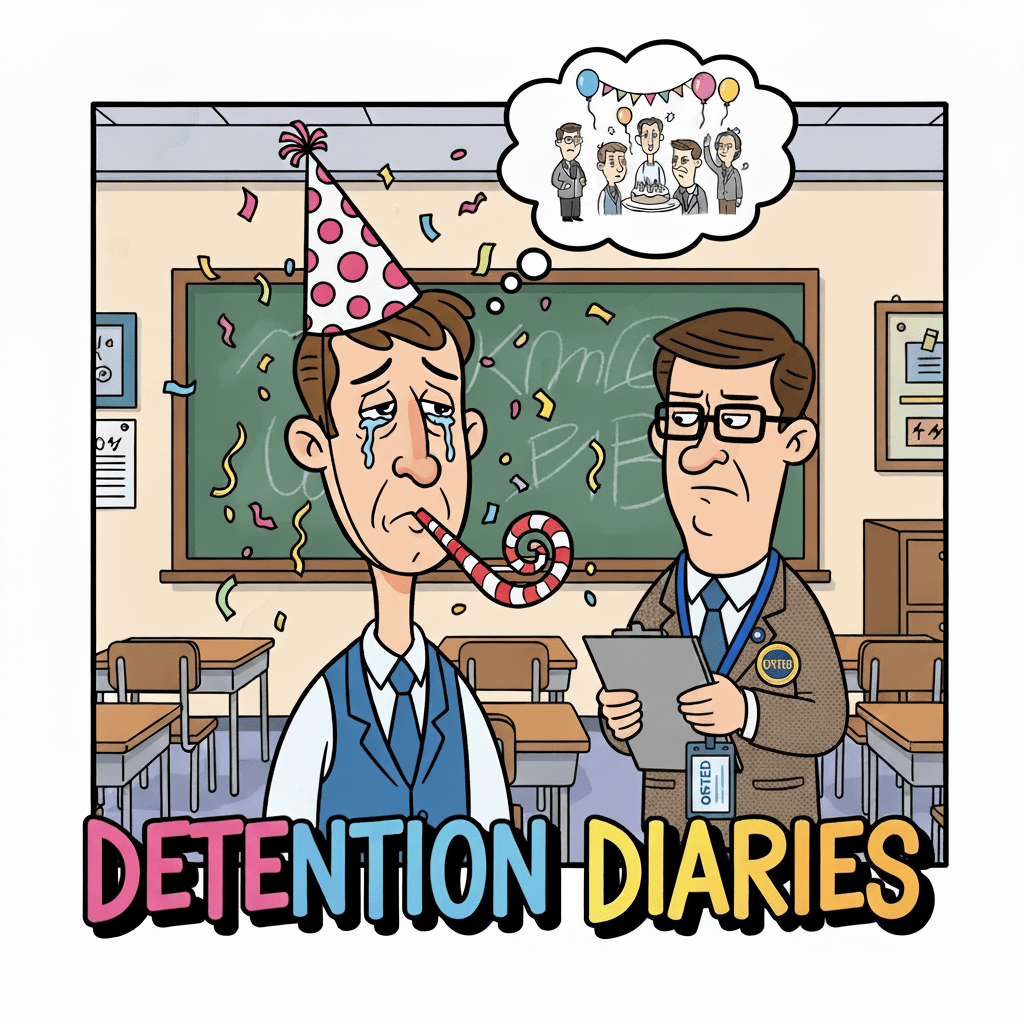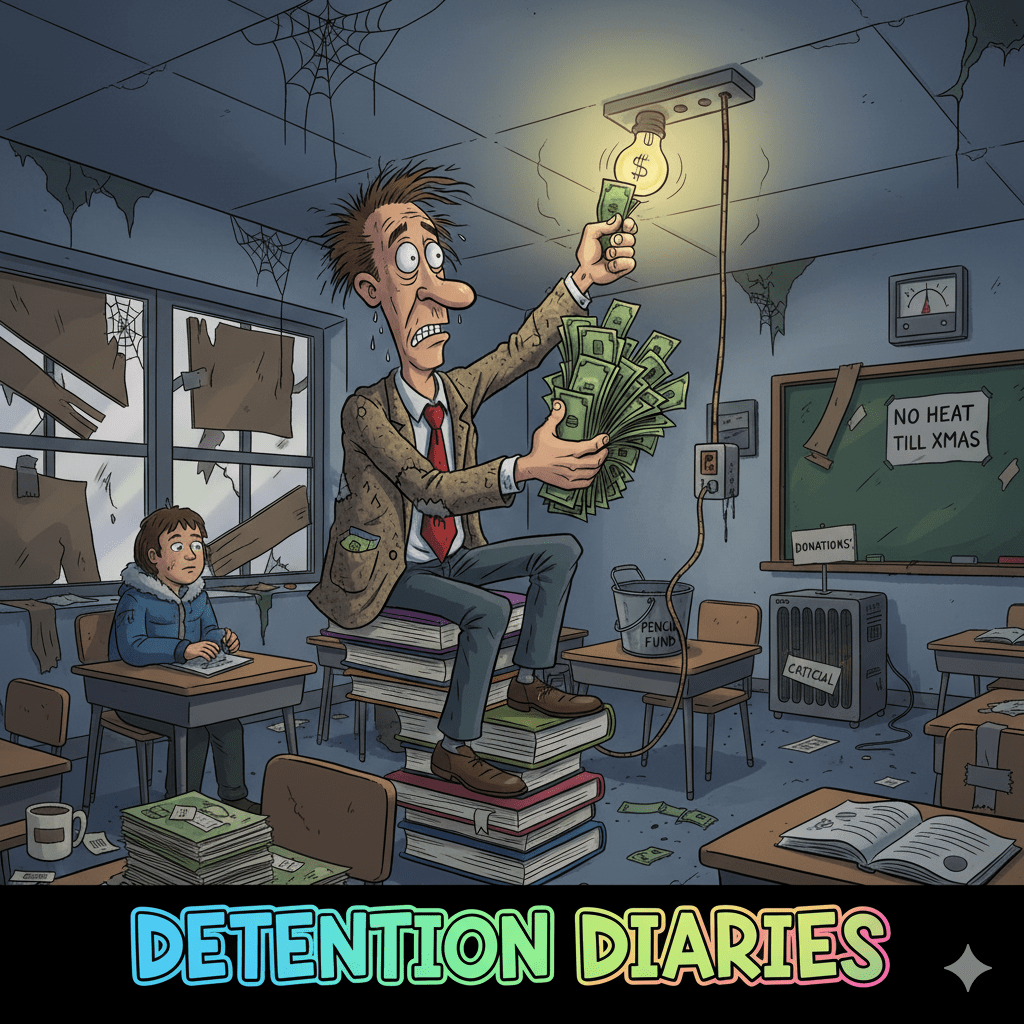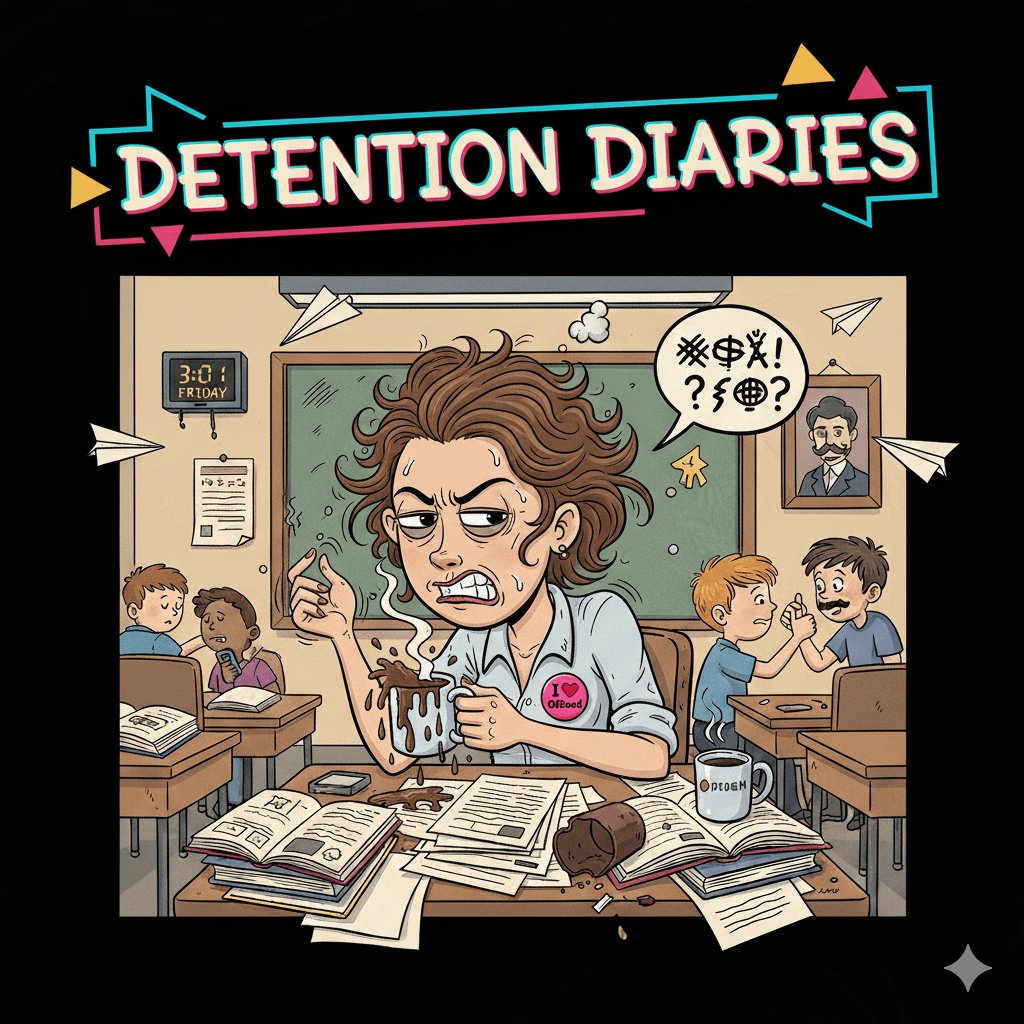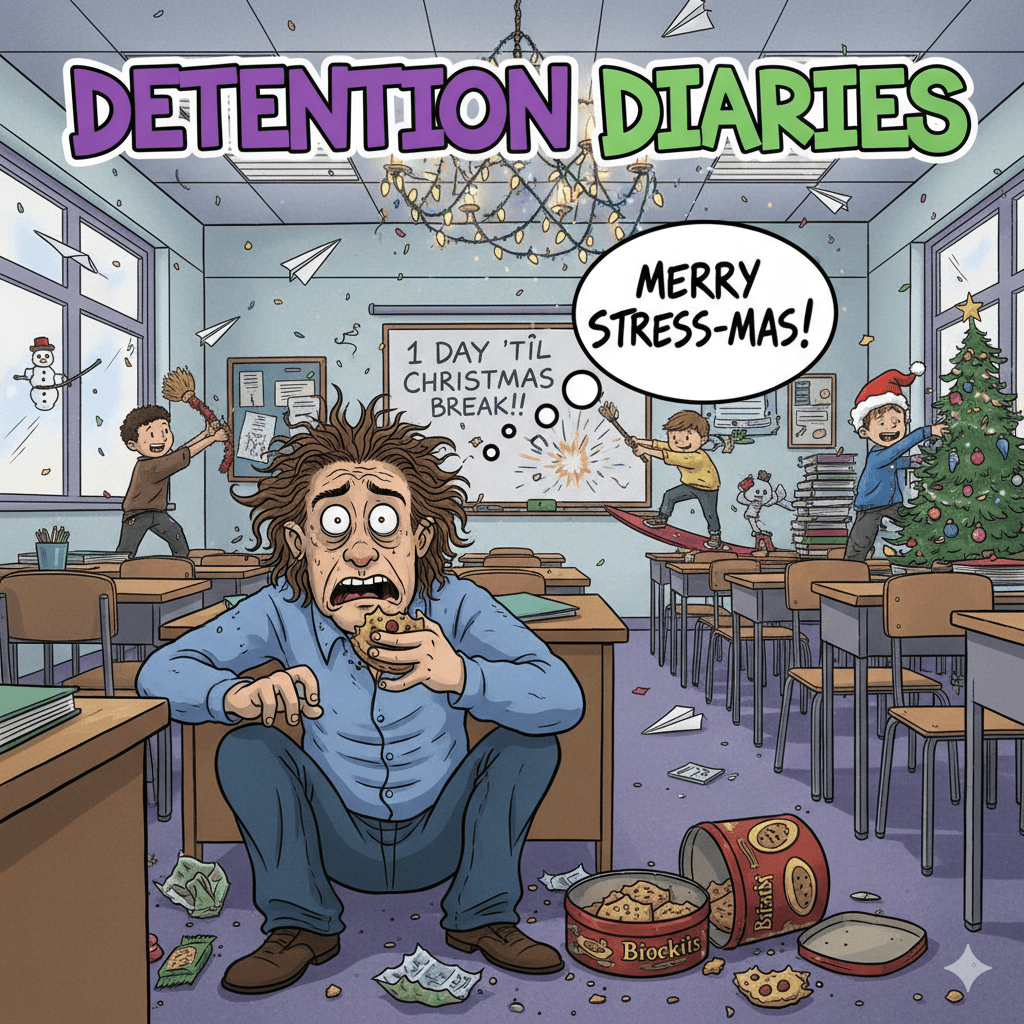
• The Great Staffroom Study – Staff Morale vs Biscuit Consumption

    Department of Educational Survival Studies
    By: A Tired Teacher, PhD (Partially Half-Dead)


    Abstract

    This week, our long-term observational study into teacher behaviour during the Christmas term has yielded critical new data.

    Findings indicate a direct correlation between (a) how far we are into the term, and (b) the speed, size, and frequency of family multipack biscuit appearances in the staffroom — along with an alarming increase in mince pie consumption per capita.

    In layman’s terms: the closer we get to the end of term, the more we’re all eating like Victorian orphans at a bake sale.


    Introduction

    The Christmas term (or “the long one,” as it’s affectionately known by those who’ve lost the will to live) is a fascinating period in teacher evolution.
    It’s marked by extreme fatigue, emotional instability, and the inability to remember which mock paper you’ve already marked.

    Staff behaviour begins to shift around mid-November. Early warning signs include:

    • Subtle murmurs of “Just need to make it to Christmas.”
    • Coffee intake reaching medically concerning levels.
    • The first sighting of a Mr Kipling variety pack in the staffroom.

    By December, this progresses to full-blown carbohydrate carnage.


    Methodology

    Over a three-week observational period, a group of researchers (also known as “teachers with no frees”) tracked the appearance and disappearance of family-sized biscuit packs and mince pies across five staffrooms in the North West.

    Data was collected using a simple metric known as the Snack-to-Sanity Ratio (SSR) — calculated by dividing the number of biscuits consumed by the number of remaining weeks until Christmas.

    To maintain accuracy, all observations were conducted covertly, usually while pretending to laminate something.


    Findings

    1. Week 1 (Early November)
      • The first “just in case” packet of chocolate digestives appears.
      • Staff exercise restraint. Someone says, “Let’s save these for Friday.”
      • Half are gone by lunch.
    2. Week 4 (Mid-November)
      • Custard creams, bourbons, and the occasional KitKat multipack now in circulation.
      • Energy levels dropping.
      • “Friday Treats” have become “Tuesday Sanity Snacks.”
      • Nobody knows who bought them. Nobody cares.
    3. Week 6 (Late November)
      • The first mince pies arrive. A hush falls across the staffroom.
      • Teachers cluster around them like pigeons at Greggs.
      • One is eaten cold, another microwaved, and a brief argument breaks out about which is correct.
      • The mince pies are gone within nine minutes.
    4. Week 7 (December)
      • Multiple tins of Roses and Quality Street appear overnight.
      • They vanish before break time.
      • Someone is seen scraping the last purple wrapper from the bottom of the tin.
      • It’s 10:43 a.m.

    Correlation Between Sadness and Mince Pies

    Data strongly supports the hypothesis that the sadder the teacher, the more mince pies they consume.

    One participant (pseudonym: “Year 11 Form Tutor”) consumed six pies in a single day after accidentally attending three separate Christmas concert rehearsals.

    Another participant (pseudonym: “Head of Department Who’s Lost Their Room to Exams Again”) was observed quietly eating a mince pie in the corridor while muttering “quality first teaching.”

    Peak consumption occurred immediately after mock exam data entry.


    Discussion

    The research suggests a clear behavioural pattern:
    As teacher morale drops, sugar intake rises exponentially.

    It’s not hunger — it’s survival instinct.
    It’s not gluttony — it’s professional development.

    The mince pie, once a symbol of festive cheer, has become a coping mechanism — a small, foil-wrapped antidepressant filled with raisins and regret.

    It’s now widely accepted among teaching professionals that eating four mince pies between P4 and P5 is “self-care.”


    Conclusion

    The study concludes that there is an unbreakable link between the proximity to Christmas and the velocity of biscuit disappearance.

    By the final week of term, time itself begins to warp. A family pack of chocolate Hobnobs left at 8:30 a.m. is but crumbs by 8:37.
    Mince pies don’t even hit the table — they’re gone before the foil cools.

    At this stage, the average teacher is 72% caffeine, 18% pastry, and 10% unresolved trauma from the carol concert.

    The final recommendation from this research?
    Don’t fight it.
    Stock up, sit down, and remember: if you’re halfway through a box of Mr Kipling’s and questioning your life choices, you’re not alone.
    You’re just in Week 7.
    Leave a comment

  • The Great Curriculum Cake: How Much More Can We Eat?

    So, the new curriculum reform guidance has finally been published this week — and, to be fair, there’s a lot to like.
    There’s talk of citizenship education, AI literacy, even understanding mortgages (which, frankly, would’ve been handy before I recently signed up for one).

    Finally, it feels like someone in the Department for Education has realised that maybe — just maybe — children need to understand the world they’re actually living in, not just what a fronted adverbial is.

    But as always, there’s a catch.

    Because while we’re talking about adding more wonderful things to the curriculum, there’s been absolutely no talk about taking anything out.

    And the curriculum is already so full it’s practically bursting at the seams.


    Bruce Bogtrotter and the National Curriculum

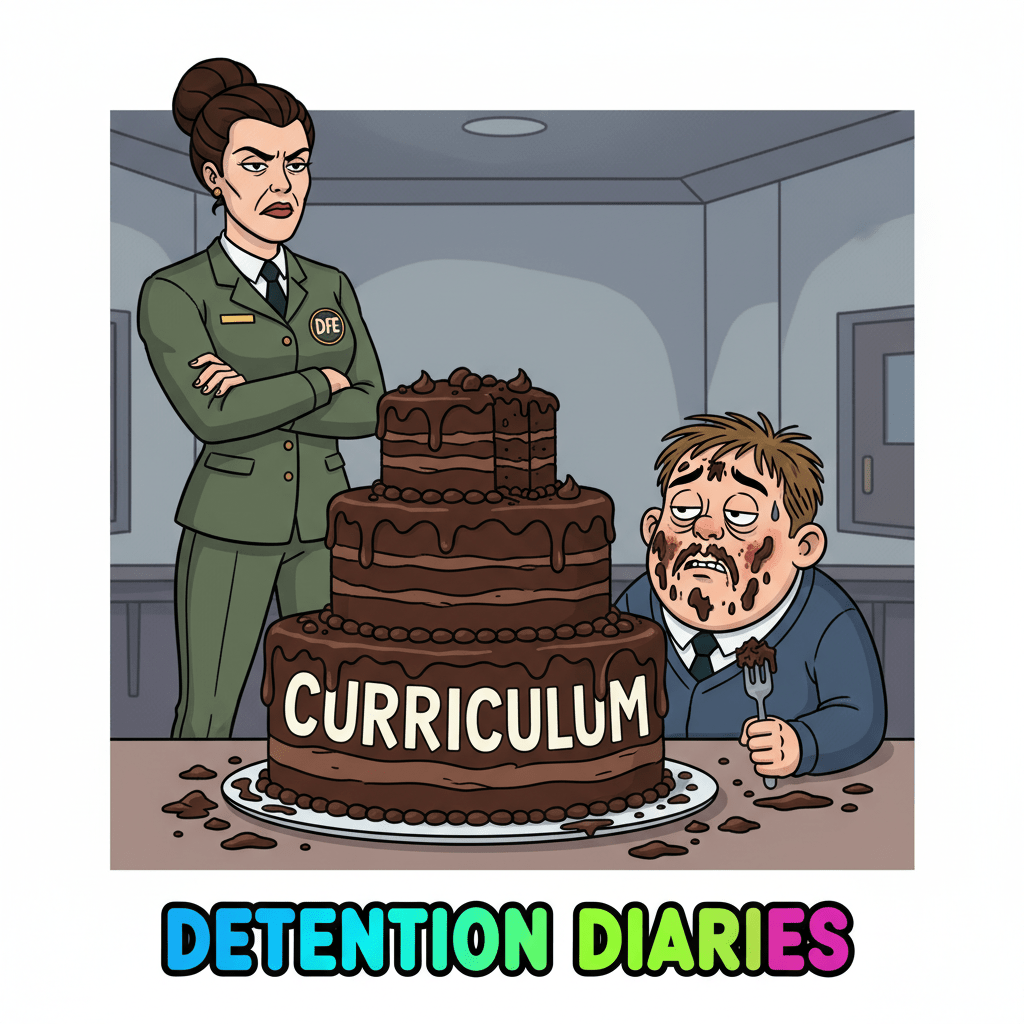
    If you’ve ever watched Matilda, you’ll remember Bruce Bogtrotter — the poor lad forced by Miss Trunchbull to eat an entire chocolate cake the size of a car tyre in front of the whole school.

    That, in a nutshell, is our curriculum.

    Students are handed an ever-growing mountain of content, told to eat every last bite, and then made to sit around 30 exams in three or four weeks.
    They struggle. They stress. They soldier on.
    And somehow — with a bit of teamwork and a lot of resilience — they pull through.

    And then, just when they think it’s over… Miss Trunchbull smashes the plate over their head.

    Pretty similar to real life after school, isn’t it?
    (Though perhaps best not to mention that bit during Year 11 assembly.)


    Adding Without Subtracting

    Don’t get me wrong — curriculum reform is absolutely needed.
    It’s overdue, in fact.
    But there’s a limit to how much you can add before the whole thing collapses under its own weight.

    We can’t just keep cramming in AI, citizenship, personal finance, and mental health awareness without removing something else.
    That’s like being served your fifth helping of cake while the waiter insists it’s for your own good.

    Schools are already overstretched, underfunded, and losing staff faster than we can recruit them.
    So where, exactly, is the time going to come from to “embed” all these new areas?
    Are we supposed to do it between the Year 10 mocks and the cover lesson for someone off with flu?

    The guidance reads like a wish list written by people who’ve forgotten that teachers aren’t wizards.
    We can’t conjure extra hours in the day or extra funding out of thin air — though, if that was on the curriculum, I’d teach it in a heartbeat.


    Farewell to the EBacc (And Not a Tear Shed)

    Now, on to some good news: it looks like the EBacc — that long-standing thorn in the side of creative education — is finally on its way out.

    Let’s be honest, the EBacc has done more damage to creative arts education than any single policy in recent memory.
    It squeezed out music, art, drama, and design to make room for an academic core that left little space for creativity, expression, or the sort of learning that actually makes school joyful.

    So yes — I’m delighted to see signs of change.
    Because maybe now we can stop pretending that creativity is optional, or something to be squeezed in during tutor time.
    Maybe now we can rebuild the arts properly — with funding, recognition, and most importantly, time.

    Because every time the government decides to “update the framework,” we’re expected to reinvent our entire curriculum like we’re working on a reboot of The Great British Bake Off.
    Except there’s no tent, no applause, and definitely no budget for new ingredients.


    A Final Slice of Realism

    So yes, the reforms have promise — citizenship, AI, real-world knowledge — all great ideas in theory.
    But here’s the thing: before we start adding new flavours, we need to make room on the plate.

    Because right now, teachers and students alike are Bruce Bogtrotter — sitting at the table, staring at the cake, wondering how on earth we’re supposed to finish it all.
    And if the DfE keeps piling more on top without taking anything off, we’ll all end up sick, sticky, and muttering something about how “at least the sponge was moist.”

    The curriculum doesn’t need more.
    It needs less — better, deeper, simpler, more human.
    Otherwise, the only people learning anything will be the ones discovering just how far you can push a teacher before they snap and start marking in interpretive dance.

    Leave a comment

  • 🎨 SENDCOs: The Artists Forced to Sign Their Own Masterpieces

    🧑‍🎨 The Unsung Artists of Education

    There’s a certain type of hero in every school.
    Not the caped kind. Not even the “I’ve got a stapler that actually works” kind.

    I’m talking about the SENDCO.

    You know — the person who somehow juggles inclusion plans, legal paperwork, staff training, broken printers, and seventeen half-written emails that all begin, “Apologies for the delay in response…”

    SENDCOs are the creative geniuses of education.
    Except, instead of being allowed to paint or perform, they spend most of their time signing forms that prove they once considered painting or performing.

    Honestly, it’s like asking Banksy to fill out a risk assessment for the wall.
    Or expecting Ed Sheeran to spend all day signing merch instead of writing songs.

    That’s the reality for so many SENDCOs right now — mountains of paperwork, minimal time with the children they’re championing, and yet they still show up with humour, heart, and a questionable relationship with caffeine.


    🎧 Enter Ginny Bootman

    This week on the Make it Make SENDs podcast, I sat down with Ginny Bootman — SENDCO, former headteacher, author, and full-time advocate for empathy and relationships in education.

    Ginny doesn’t just talk about inclusion — she lives it. She’s got this incredible knack for cutting through the admin fog and reminding us what SEND is really about: people.

    In our conversation, we talked about:

    • The art of empathy in leadership
    • Time management (and the myth of “free periods”)
    • Staying human in a job that often feels superhuman

    …and of course, we laughed. A lot.


    ▶️ Listen to the Episode

    🎙️ Episode: Follow the Empathy Road – Educating for Inclusion with Ginny Bootman
    Listen now on Spotify, Apple Podcasts, or wherever you get your podcasts.

    🖋️ To Every SENDCO Out There…

    Next time you’re elbow-deep in an EHCP and wondering if this is what you signed up for, remember:
    you are the artist.
    It’s just that your canvas happens to be a very large pile of paperwork.

    Keep fighting the good fight — one referral form, one phone call, one perfectly laminated visual timetable at a time.


    🙌 Thank You, Ginny

    Check out Ginny’s work:


    💬 Join the Conversation

    🌐 Join the Detention Diaries community:

    If you like what you hear, please follow, like and share the podcast so more teachers, parents and SEND champions can find us.

  • Sunday Night: The Fear, The Flatulence and The Festive Delusion

    By The Disgruntled Teacher

    It’s Sunday night.

    Your stomach has begun its weekly interpretive dance routine. The mysterious rock you swallowed sometime around 4pm has now settled just under your ribcage. Your bowels are whispering, “Monday is coming…”

    Tomorrow… school.

    But breathe. You’re not alone. And more importantly — you’ve survived every other Sunday before this one.

    To the Teacher Currently Wrapped Like a Human Sausage Roll

    It’s ok if you’re not ready.

    It’s ok if your lesson plan is currently just the word “powerpoint?” written in biro on a Tesco receipt.

    You’re not supposed to be perfect. You’re supposed to be functioning… ish.

    Because look at what you’ve already endured:

    • A CPD session where someone suggested “mindfulness corners” for Year 10 boys who punch walls for sport.
    • A printer that only works when Mercury is in retrograde and you’ve sacrificed three glue sticks to it.
    • Three new policies, all contradicting each other, all sent at 11pm with the subject line: URGENT – MUST READ.
    • A child who asked if Beethoven “was that blind bloke who invented pasta.”
    • “Learning walks” that involve senior leaders materialising like dementors the moment you press play on a video.
    • And of course, the fire alarm — triggered not by fire, but by someone burning toast in the staffroom again.

    Yet you’re somehow still teaching, still turning up, still pretending your eye isn’t twitching.

    The Joy of the Closed Classroom Door

    Once you’ve survived:

    • Leadership drive-bys
    • Policies that reproduce like rabbits
    • That colleague who starts every sentence with “Well at my old academy trust…”

    You can shut your classroom door.

    And for a little while, it’s just you, your kids, and a lesson that might actually be fun.

    Some will be up for it.

    One might even say, “This is sick, Miss/Sir.”

    Another will still forget their pen — but that’s just the natural order of things at this point.

    You’re Doing Alright, You Know

    Take it one day at a time.

    Smile when it’s possible.

    Internally scream when necessary.

    Reward yourself with biscuits like you’re on rations.

    Perfection isn’t required. Effort is. And you’re already doing that.

    And Don’t Forget…

    • It’s nearly Christmas.
    • Soon you’ll be teaching “Jingle Bells” on rusty glockenspiels and calling it curriculum.
    • You can legally pour Baileys in your staffroom coffee and call it “festive resilience”.
    • There will be mince pies, ABBA at the staff party, and at least one drunk PE teacher doing karaoke.
    • And yes — it’s socially acceptable to be slightly drunk on a Monday in December. It’s called “seasonal coping”.

    Feliz Navidad, educational warriors.

    You’ve got this.

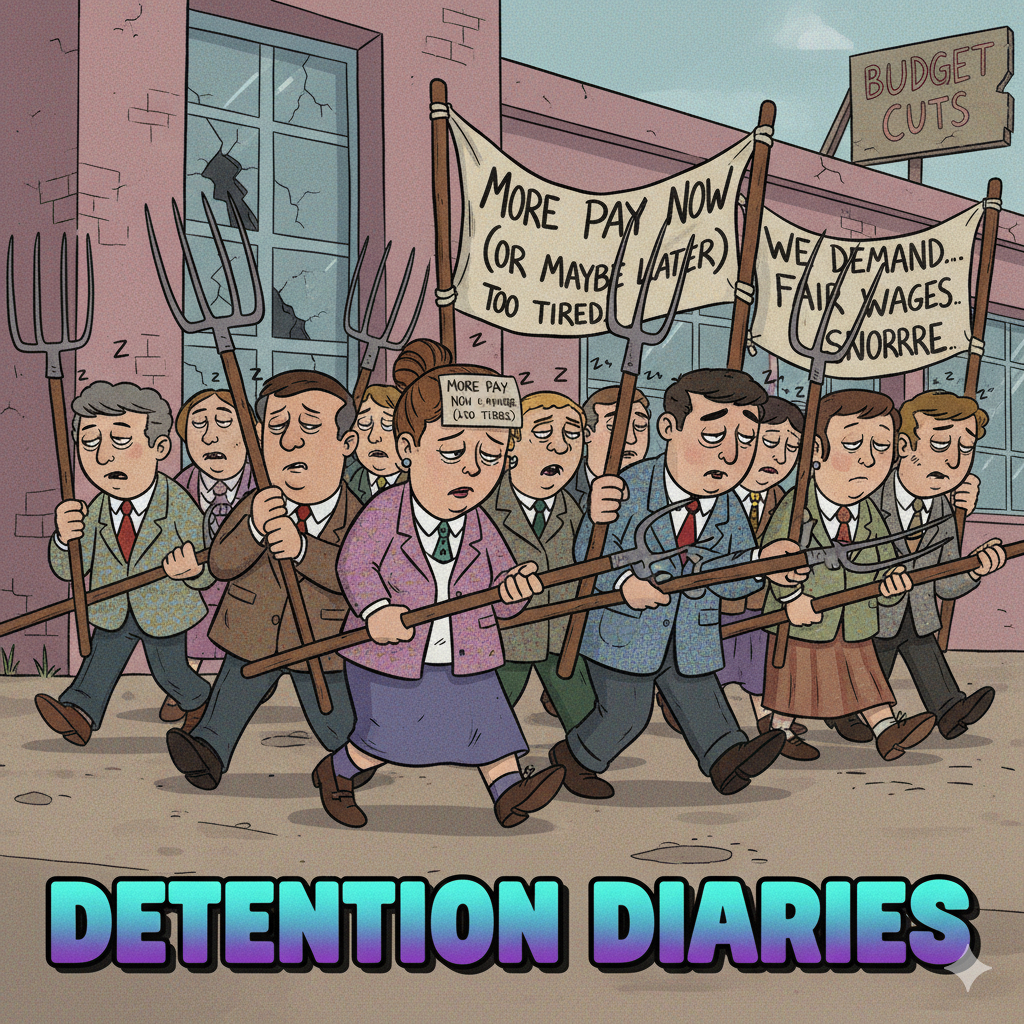
  • Where Are Our Pitch Forks!?

    Are we asleep at the wheel?

    Right, colleagues. Gather round the metaphorical staffroom table. Because I’ve just read something that makes me wonder if we’ve all gone completely numb.

    The Department for Education has announced a recommended 6.5% pay increase over the next three years for teachers.

    Lovely headline. Almost warm and fuzzy.

    Except — and there’s always an except, isn’t there? — there’s no indication that it’s actually funded.

    So basically: “Here’s your raise. Please pay for it yourself.”

    Meanwhile, the economy staggers on. Let’s have a look at some figures, because numbers make fury sound intellectual.

    Britain, France and the Financial Farce

    The UK’s GDP in 2024 (that’s the total value of everything we produce, at current market prices) sits at about US $3.64 trillion.

    France is catching up fast, sitting at US $3.21 trillion.

    Now, you might think: “Ah well, at least we’re still ahead.”

    But here’s the funny bit — France has just had its credit rating downgraded because it can’t quite manage its public finances. Which, if countries were people, would be the equivalent of that mate who can’t be trusted with the kitty on a night out because they’ve already spent it on prosecco.

    And despite all that, when the French government tried to raise the retirement age by one year, they didn’t shrug and say “that’s unfortunate.”

    They set Paris on fire.

    Meanwhile, over here, our government can announce an underfunded pay deal, increase workloads, merge classes, and we’ll all quietly mutter “classic” before heading off to do lunchtime duty.

    So again I ask — where are our pitchforks?

    Inflation vs Pay: The Maths Bit (Don’t Worry, It’s Funny… Sort Of)

    Here’s how this supposed pay rise really plays out:

    Inflation in the UK is forecast to hover around 3.4% in 2025, and maybe 2.5% in 2026. So prices are still rising — not quite panic-buying-toilet-roll levels, but enough that your weekly shop feels like you’ve accidentally upgraded to Waitrose.

    Now, our shiny new 6.5% pay rise spread over three years equals roughly 2% a year.

    So while your payslip is creeping up like a nervous snail, your bills, mortgage, and food shop are running the London Marathon.

    It’s like getting a pay rise, but every time you celebrate, your energy company emails you with a little reminder that you’re still skint.

    Your “increased salary” basically means you can afford half a Freddo more each month.

    And that’s if you don’t print anything in colour.

    In other words: spending power down, sarcasm levels up.

    In Schools: Bigger Classes, Smaller Morale

    Meanwhile, the reality on the ground is about as uplifting as a wet playground duty.

    At my school:

    • Classes are bigger.
    • We’re merging groups when staff are off — saving money, yes, but also making it impossible to teach effectively.
    • Recruitment? Frozen.
    • Teachers? Leaving.

    We’re stretching what we’ve got so thin, it’s practically transparent.

    It’s sold as “making efficiencies” but what it really means is “you’ll be teaching 32 kids with three broken keyboards, no TA, and the promise of a 2% annual pay rise to keep you motivated.”

    Vive la (British) Revolution?

    So let’s recap.

    France riots if the government changes the retirement age by a single year.

    We… update our seating plans and moan to whoever’s waiting for the kettle to boil.

    France loses its credit rating; we lose our patience, then shrug, mark three more books, and eat a stale biscuit.

    We’re basically the calm cousin at the family wedding — quietly holding everyone’s coats while chaos unfolds, whispering “it’s fine” through gritted teeth.

    But maybe it’s time we stopped being so polite about it all.

    Because this 6.5% “rise” isn’t generosity — it’s a consolation prize in Monopoly money.

    It doesn’t fix recruitment. It doesn’t make classes smaller. It doesn’t stop teachers burning out or schools merging groups to “cover gaps.”

    So, once again — where are our pitchforks?

    Are they in the cupboard under the stairs, next to the unused glue guns and that box of defunct mini whiteboards?

    Or are we saving them for a rainy day… which, let’s face it, in Britain, is most days?

    Either way, we’d better dust them off soon.

    Because at this rate, we’ll need them just to fight over the last working stapler.

    Leave a comment

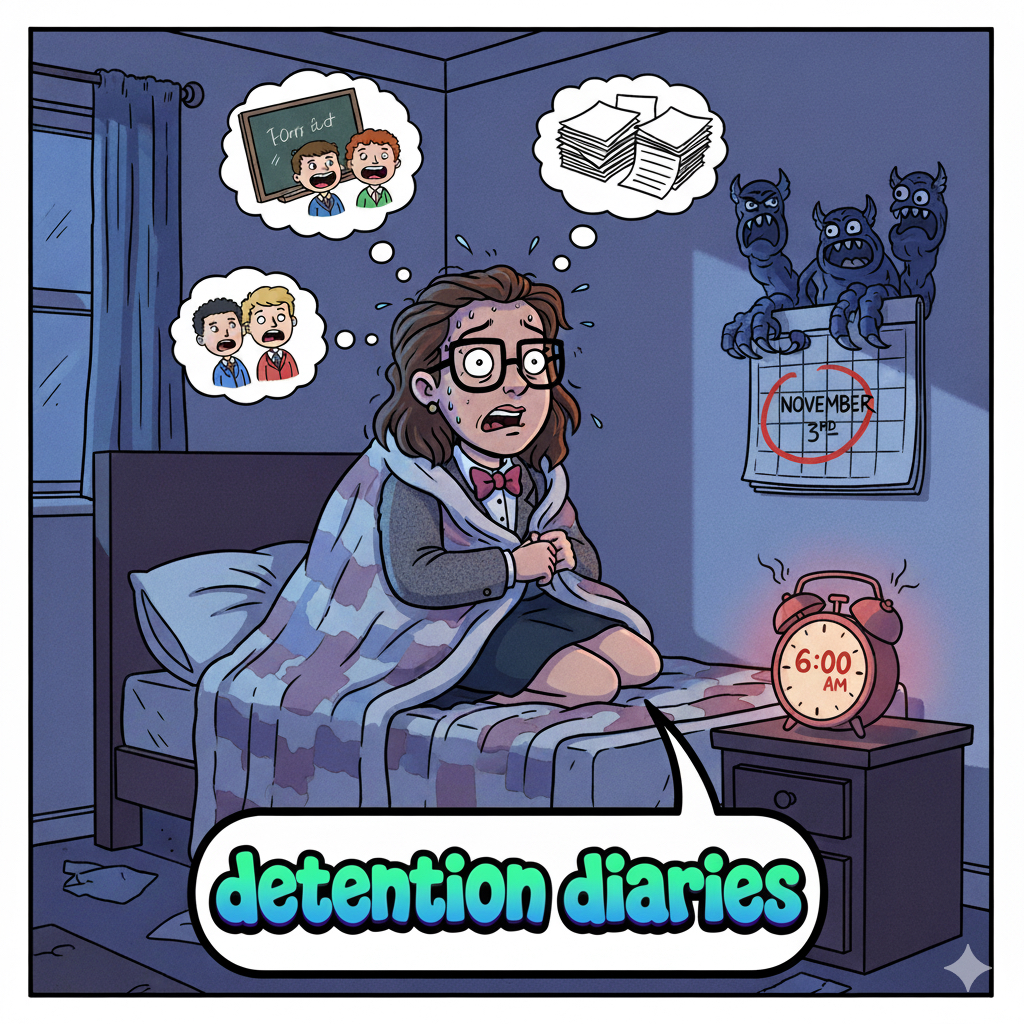
  • The Eye of the Storm (or October Half Term)

    It’s half term. We’ve made it.

    Just about.

    Eight long weeks of teaching, marking, data drops, detentions, and detangling headphone wires from confiscated phones.

    We’ve crawled to the finish line, our souls held together by caffeine and passive aggression, and now… here we are.

    Half term.

    The calm between storms.

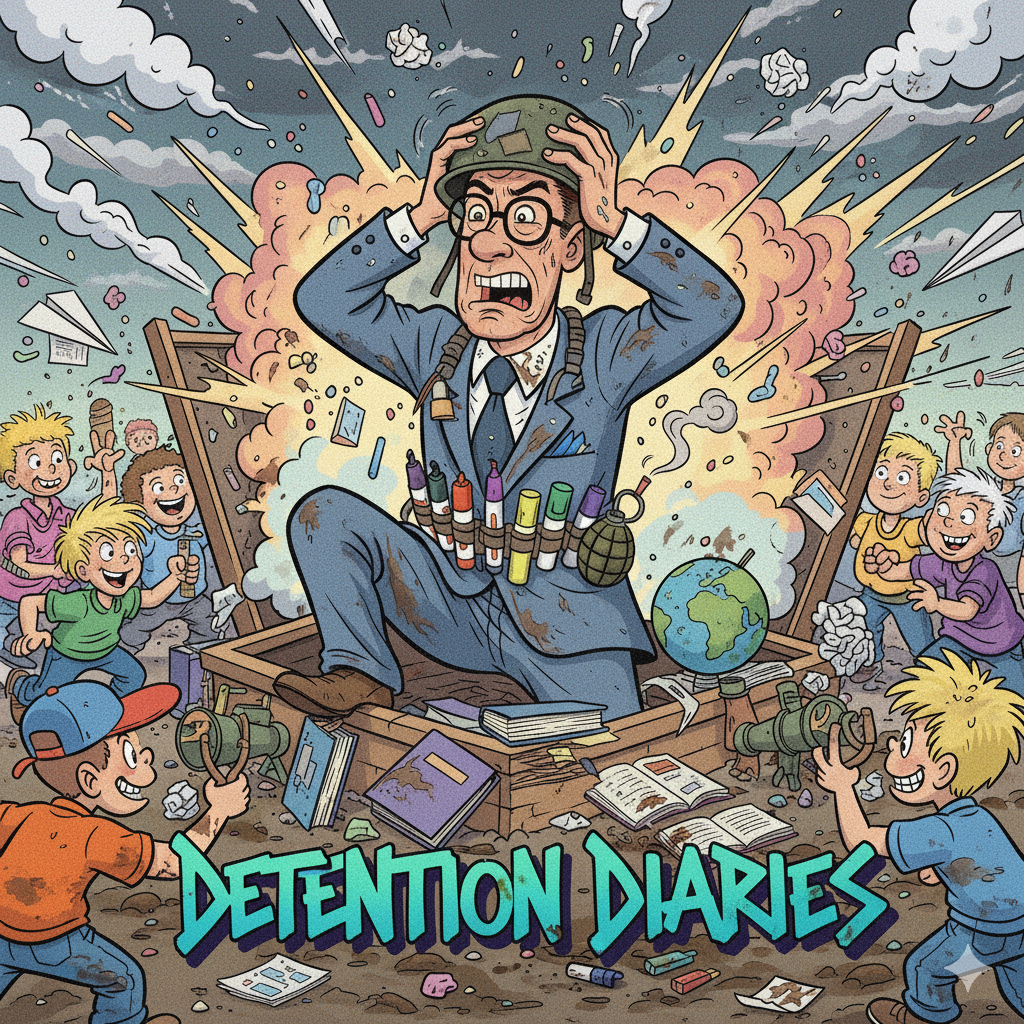
    The briefest of respites before the final push to Christmas — which, as every teacher knows, is less “It’s the Most Wonderful Time of the Year” and more “Saving Private Ryan: Festive Edition.”

    The Enemy on the Hill

    We’re midweek into the break now.

    The laundry’s done. The sleep debt is partially repaid.

    And yet… there’s a faint rumble in the distance.

    The enemy is regrouping.

    They’re on the hill.

    You can practically smell Year 9 from here.

    Somewhere out there, a 14-year-old is filming a TikTok with the caption “Miss is so moody” — and you can feel it in your bones.

    By Saturday, the anxiety will start creeping in. By Sunday, it’ll be full-blown Year-9-parade-ground flashbacks.

    And by Monday, we’ll all be back in the trenches, armed with whiteboard pens and misplaced optimism.

    Cold, Dark Nights and Fluorescent Lights

    This time of year is always strange.

    The nights close in, the corridors smell faintly of Lynx Africa and despair, and staffroom conversations start with:

    “Just gotta make it to Christmas.”

    That’s the phrase that gets you through: “Just gotta make it to Christmas.”

    Not joyfully — more like a soldier whispering a mantra before charging into no man’s land.

    And of course, cover is everywhere.

    Teachers dropping like flies, viruses spreading faster than Year 7 gossip, and everyone else doing triple lessons in rooms that haven’t been cleaned since 2003.

    You try not to resent the absent ones — you really do — but by Friday afternoon you’re half-convinced that “sickness bug” might actually be “early Christmas shopping and a latte.”

    The Kids Who Don’t Want Christmas

    And then there’s the other side.

    Because for every member of staff counting down the days until they can collapse on the sofa with a tin of Roses, there are kids who are dreading the holidays.

    You know the ones.

    The ones who come to school hungry, or cold, or quiet.

    The ones who act out because the structure of school is the only structure they’ve got.

    For them, Christmas isn’t magic — it’s messy.

    We joke about how chaotic the run-up is, how “the kids go feral in December,” but sometimes it’s because they can feel the uncertainty ahead.

    And that’s the bit that sticks with you, even when you’re moaning about your workload.

    Because you know — underneath the chaos — school is the safest place they’ve got.

    Saving Private Ryan: Christmas Term Edition

    If you’ve ever watched Saving Private Ryan, there’s that final scene where Matt Damon’s character is sat on the ground, clutching his rifle, surrounded by smoke, rubble, and chaos.

    He looks broken. Exhausted. Haunted.

    That’s every teacher in the last week of term.

    We’re all Matt Damon — clutching a pile of unmarked books, staring into the middle distance as a student asks if we can watch a film “because it’s nearly Christmas.”

    The building’s shaking. The photocopier’s jammed. The supply teacher’s gone missing.

    And somewhere in the distance, a child’s playing Jingle Bells on a glockenspiel. Badly.

    That’s the vibe.

    That’s December in a British school.

    But for now — in this tiny, quiet half term eye of the storm — we sit.

    We drink tea. We scroll. We pretend the email app doesn’t exist.

    Because we know what’s coming.

    The Christmas term.

    The last stand.

    The longest, loudest, glitteriest battle of them all.

    And when we finally emerge on the other side — bruised, broken, dusted in tinsel — we’ll raise a glass (or a Gregg’s festive bake) to each other and say,

    “We made it.”

    Then we’ll go to bed at 8:30 and not move until Boxing Day.

    enjoy it while it lasts.

    Get ready for the whistle because we’re about to go over the top!!!

  • I know… Let’s have another meeting about it!?

    CPD: The Endless Cycle of “Learning to Learn”

    I’ve lost count of how many CPD articles I’ve seen lately.
    Apparently, teachers must now learn how to learn, learn what to learn, and occasionally learn why we’re learning what we’re learning — all while learning to reflect on the learning we’ve just learned.

    Don’t get me wrong — professional development is important. But it feels like we’ve entered an age where CPD has become a kind of competitive sport.
    “Look at my bespoke pedagogical reflection framework!”
    “Oh, you still use the four part lesson? How quaint.”

    Half the time, I wonder if anyone in the private sector spends this much energy being told what they should be learning.


    Do They Have CPD in the Real World?

    Do people in the private sector sit in meeting rooms on a Friday afternoon, PowerPoint slide glowing, being told how to “embed a culture of metacognitive autonomy”?
    Do accountants have “Termly Reflection on Spreadsheet Efficacy”?
    Do plumbers get an INSET day on “Mastering Adaptive Pipework”?

    I’m not convinced they do.
    And maybe that’s because they’re trusted — trusted to identify what they need to develop, trusted to do their job, and trusted not to spend an entire afternoon being shown a video about “growth mindset in the workplace.”

    Meanwhile, teachers — highly educated professionals who somehow hold the nation’s future together with glue sticks and caffeine — are given two hours on “effective plenaries.”
    We’re constantly being told how to improve, even when what we really need is a nap, a biscuit, or a moment to think for ourselves.


    The Great Perk Divide

    It’s funny, though.
    Every time I scroll through social media, I see the private sector complaining about how much time off teachers get.

    “Oh, must be nice having six weeks off in summer!”
    Yes. It is nice. It’s also the only time we’re not running on adrenaline and caffeine.

    But then, on the other hand, I hear teachers moaning about the private sector’s perks.
    They get bonuses, lunches, gym memberships, and company-funded ski trips.
    Ski trips! We can barely get approval for a school trip to the local museum without filling out three risk assessments, a staff declaration form, and a blood oath.

    They get to drink wine at lunch on a Friday — we get to drink tepid coffee out of a “World’s Okayest Teacher” mug while marking Year 9 homework that looks like it was written by someone in a moving car.

    So who’s really winning here?


    Time or Treats?

    Maybe that’s the ultimate question: would you rather have more time off, or more perks while you’re there?

    Private sector: “We got a team-building day in the Alps!”
    Teachers: “We got a stapler that actually works.”

    Private sector: “My boss gave me a bottle of wine for hitting my targets!”
    Teachers: “My boss gave me an A3 laminated version of our school’s new vision statement.”

    The grass always looks greener — until you realise both lawns are full of weeds, meetings, and people pretending to understand spreadsheets.


    At the end of the day, teaching will always be its own strange ecosystem — one where we talk endlessly about learning, reflection, and growth, but rarely get the space to do any of it properly.

    Maybe that’s why CPD feels so tiring.
    It’s not that we don’t want to learn — it’s that we want to choose what matters to us instead of being told what the latest acronym demands.

    So yes, maybe the private sector does get better perks. But we get something far rarer: the joy of collapsing into the summer holidays like a zombie who’s just seen daylight.

    And honestly? You can keep your skiing trips.
    Just give me a working photocopier, a hot brew, and a week without someone saying “let’s unpick the learning.”

    That’s my kind of professional development.

    Leave a comment

  • Don’t worry, Ofsted has got your back!

    No Surprises, Really?

    This week, TES ran with Ofsted’s latest claim that their new inspection model will mean schools face “no surprises.”

    “No surprises.”
    From Ofsted.

    That’s like Greggs announcing a fine-dining restaurant — technically true, but it still feels like a practical joke.
    (Although, to be fair, there is one in Newcastle — the Greggs Champagne Bar. You can now sip bubbly while eating a sausage roll. Britain really is a land of contrast.)

    But back to Ofsted — who seem to think that turning up unannounced, with clipboards and cryptic smiles, counts as a collaborative process.

    Schools are told inspections should be “transparent” and “supportive.” Yet staff are still scrubbing display boards at 10pm, colour-coding seating plans, and printing off policies that were last read when Michael Gove had job security.

    The “no surprises” line isn’t comfort — it’s PR.
    And the only real surprise is that they think anyone’s still buying it.


    SENDCOs: Running the Marathon While Carrying a Sofa

    Meanwhile, in the real world, our SENDCO — a man with the patience of a saint and the inbox of a call centre — is doing everything short of splitting atoms to keep the system afloat.

    He’s juggling EHCPs, liaising with outside agencies, supporting staff, and holding the emotional weight of parents (like me) who are exhausted by the system.
    His last review meeting with us was six months ago — and it took that long just to get it implemented. Not because of him, not because of the school, but because our local authority is overwhelmed and under-resourced.

    We only saw movement after six months of chasing, nudging, and, let’s be honest, pestering until something finally shifted.

    And this is the point, isn’t it? SENDCOs aren’t failing — they’re drowning. They’re expected to deliver miracles in a system that’s running on fumes. The talk of “investment in SEND” feels like a cruel joke when the only thing growing is the paperwork pile.


    MATs and the Myth of Efficiency

    In my previous post, “Where’s All the Money Gone, Again?”, I talked about the financial black hole that is the modern Multi-Academy Trust.
    Since then, nothing’s changed — except maybe the size of the CEO’s pay packet.

    We’ve got trusts tightening school budgets while splashing out on new “executive leadership tiers,” “strategic consultants,” and “innovation leads.”
    Headteachers are told to “do more with less,” which roughly translates to: “You’re on your own, but please be outstanding while you’re at it.”

    There’s a grotesque irony to it all. You’ve got classroom staff scrabbling for glue sticks while an “executive associate director of transformation” is signing off a £250,000 salary and a LinkedIn post about “visionary leadership.”

    At this point, MATs don’t resemble communities of schools — they look like start-ups with a safeguarding policy.


    SEND Reform: A Year of Waiting for Nothing

    And then there’s the SEND white paper.
    Remember that? The grand promise to reform the entire system?

    It’s now delayed until 2026, which will mark a full year since it was first announced.
    A year of waiting, while teachers, parents, and children sit in limbo.

    As both a teacher and the father of an autistic little girl, it’s maddening.
    Every delay means another year of families fighting through bureaucracy, another year of schools trying to make do without funding, another year of children falling through the gaps while ministers rehearse phrases like “transformational reform” in front of a mirror.

    It’s not reform anymore — it’s a slow-motion shrug.


    The Weight of It All

    So, in summary:
    Ofsted insists there’ll be “no surprises.”
    MATs keep stacking management like Jenga.
    SENDCOs are being asked to do the impossible.
    And the long-awaited reform? Still pending.

    It’s all cloak, shadow, and delay — a masterclass in how to appear busy while standing perfectly still.

    And yet, despite it all, schools keep going. Teachers keep showing up. SENDCOs keep juggling. Parents keep pushing.

    We keep doing the work, even when the people above us are too busy sipping metaphorical champagne to notice the cracks.


    Because that’s the state of British education in 2025:
    Some of us are serving sausage rolls and surviving on caffeine —
    while others, apparently, are dining on bubbles at Greggs.

    Leave a comment

  • Where has all the money gone, again?

    Really slowly… then all at once!

    Every few months something happens that makes you think. Something that opens your eyes to something you perhaps knew was there but didn’t really pay attention to. Perhaps there was a little wet patch above the lounge “It’ll be alright, we’re coming up to winter, perhaps its just condensation”. Maybe there is a slow puncture on your tyre, you keep filling your tyres with air and you know you’ve got to change it eventually “I’ll get it sorted next week.”.

    Then comes a report that opens your eyes and you realise the problem is far worse than you thought. That wet patch above the lounge is in fact a leaky pipe and the first floor has flooded without you knowing. That slow puncture is in fact something wrong with the suspension and you need to get some serious work done on your car.
    The NASUWT’s Where Has All the Money Gone? is one of those.

    A report that confirms what we already feel every single day: schools are struggling, not because teachers don’t care or try hard enough, but because money is being swallowed up by a system that’s become more about management, middlemen, and marketing than about children and learning.

    The report highlights billions being drained from frontline education — and as someone living both in education and alongside it as a parent of a child with additional needs, I can tell you firsthand: it shows.


    The Reality Behind SEND Spending

    The report’s section on SEND hit me hardest. It says private providers are charging as much as £61,500 per child per year — that’s nearly triple what state provision costs.
    On paper, you’d expect that kind of money to mean gold-standard support, specialist help, and truly tailored provision.
    In reality, it often doesn’t.

    As a parent trying to get help for my autistic daughter, I’ve seen how exhausting and confusing the system is.
    You’d think that once you have a diagnosis, the help would slot into place — support in school, professionals who understand, adaptive teaching, and genuine conversations about how she can thrive, not just survive.
    But it’s not like that at all. It’s forms, assessments, waiting lists, emails to nobody, and more forms. You end up fighting the system that’s supposed to be fighting for your child.

    So when I read that billions are being spent on SEND services and support contracts, I have to ask — where’s the impact? Where’s the human bit?
    Because for all the talk of inclusion and “quality first teaching,” what I see is overstretched teachers doing their absolute best without the resources or training they need, and children slipping through the cracks while money slips out of the system.


    The Business of Education

    Education is no longer a sector — it’s an industry.
    We’ve got Multi-Academy Trusts (MATs), private consultants, management firms, data contractors, HR services, outsourced payroll, behaviour intervention teams, agency teachers, and “school improvement” companies — all making tidy sums from public money that used to go directly into schools.

    There’s a whole ecosystem built around education, and everyone’s feeding from it except the people actually in the classroom.
    It’s fragmented, messy, and full of duplication. One MAT might be paying one company for “strategic leadership training,” while another pays for the same thing rebranded with a new logo.
    Meanwhile, actual teachers are told to reuse exercise books and print double-sided to save paper.

    When did education stop being about the children and start being about the contracts?


    The Cost of Keeping the Lights On

    Then there’s the issue of cover.
    Schools are now spending millions just to have a body in the room. Not necessarily a qualified teacher — just someone to keep the peace, supervise a worksheet, and make sure nobody throws a chair.

    The NASUWT report says schools spent around £1.2 billion on supply teachers last year, with £300 million going straight to agencies.
    That’s £300 million that could have been used for proper teacher recruitment, training, or retention — you know, the things that actually stop people from leaving in the first place.

    We’ve reached a point where we’re paying to prop up the symptoms of a broken system rather than fixing the causes of it.


    Too Many Chiefs, Not Enough Teachers

    Some MATs now have four layers of management above the headteacher.
    Four.
    You’ve got the CEO, the deputy CEO, the regional director, the executive principal, the cluster lead, the area improvement strategist (whatever that means), and then, finally, the person who actually runs the school.

    Some of these executives are earning over £250,000 a year. A few, apparently, are on more than £500,000.
    Let that sink in.
    The Prime Minister earns around £170,000.
    So yes — we now live in a country where the leader of a group of schools can earn significantly more than the leader of the country.

    And I’m sure they’ll say it’s because of the “scale of responsibility” or the “complexity of leadership.” But if the system they’re leading is underfunded, short-staffed, and leaking money, how complex can it be?

    It feels less like a network of schools and more like a corporate pyramid scheme with a safeguarding policy.


    Sometimes I wonder what would happen if we stopped paying for extra layers of management and instead paid for time. Time for teachers to plan properly, to talk to students, to actually collaborate. Time for SEND teams to work with parents, not just around them.

    The money’s there — it’s just being vacuumed upwards instead of poured where it matters.

    And honestly, at this point, I wouldn’t be surprised if the next report revealed that a MAT CEO is earning loyalty points on the government’s moral credit card.

    Because when a system meant to nurture children becomes one that rewards profit and PowerPoint slides, it’s clear that the crisis isn’t in teaching — it’s in leadership.

    Now if you’ll excuse me, I’m off to email my local authority again about my daughter’s support plan.
    I expect a reply around 2043.

    Leave a comment

  • The ‘Everything’ Crisis

    “It’s Not a SEND Crisis – It’s an Everything Crisis”

    At this point, I think we can all agree that “crisis” has lost its meaning in education.
    We’ve had funding crises, recruitment crises, behaviour crises, and now, the big one — the SEND crisis.

    Except it’s not really a SEND crisis, is it?
    It’s an everything crisis.

    It’s what happens when years of underfunding, over-promising, and “doing more with less” finally meet in one overcrowded classroom, where you’re trying to deliver “quality first teaching” to thirty-two students with five different seating plans and a dodgy projector.


    The SEND Situation: Quality First, But First We Need Quality Conditions

    We’re expected to deliver adaptive teaching for every learner — to tailor, tweak, and transform lessons so that every child can access the curriculum.
    That’s fine. That’s good teaching. But let’s be honest — it’s getting harder to do it properly.

    We talk a lot about “quality first teaching,” but right now most of us are firefighting.
    We’ve got larger class sizes than ever, dwindling support, and the growing need to cut costs on cover — which means more non-specialists parachuted into classrooms and less consistency for students who desperately need it.

    Teachers want to help every child succeed. We genuinely do. But the system is working against us. We’re told that if we just try harder, or use the right buzzword in a lesson plan, everything will be fine.
    Spoiler: it isn’t fine.
    We’re doing our best, but the truth is, the foundations are cracked, and the cracks are widening.


    Ofsted’s New Framework: A Riddle Wrapped in Acronyms

    And then there’s Ofsted.
    Because when you’re already juggling chainsaws blindfolded, what you really need is a new framework.

    This one, apparently, focuses on “curriculum quality,” “behaviour and attitudes,” and “personal development.”
    It sounds noble. It always does. Until you read the fine print and realise that it’s basically the same expectations, repackaged with a different set of PowerPoint slides.

    We’re told accountability is good — and yes, it is. But this version of accountability feels like being told to fit a one-size-fits-all hat that’s clearly three sizes too small.
    Schools are unique. Communities are different.
    Yet, we’re all being measured by the same ruler, regardless of context.

    And the new buzzword is “coherence.” Everything must be “coherent.”
    Because nothing says “improving teacher wellbeing” like staying up until 10pm trying to make your curriculum map look coherent enough to avoid a week of heart palpitations when the phone rings with “the call.”


    Teacher Retention: We Don’t Want Champagne, We Want Time

    And then there’s the retention crisis.
    Apparently, teachers are leaving in droves because they’re underpaid.
    Sure — that’s part of it. But it’s not the full story.

    You can throw all the recruitment bonuses in the world at the problem, but it won’t fix what’s really wrong.
    Teachers don’t want champagne and bonuses.
    We want time.
    We want to do our jobs properly without drowning in admin.
    We want to feel trusted to teach instead of being inspected into the ground.

    It’s not about the pay rise (though, let’s not kid ourselves — it wouldn’t hurt).
    It’s about being treated as professionals instead of performance data.


    Where That Leaves Us

    So here we are.
    In classrooms that are fuller, budgets that are tighter, and expectations that are somehow higher.
    We’re tired, but we still care — and that’s the part that hurts the most.

    Teachers aren’t leaving because they’ve stopped loving teaching.
    They’re leaving because it’s becoming impossible to do it well in the system we’ve been handed.

    Maybe one day, we’ll get a version of education that works for everyone — staff, students, and the system itself.
    Until then, we’ll keep doing what teachers always do:
    Making something out of nothing, laughing at the chaos, and surviving on caffeine, camaraderie, and the faint hope that someone, somewhere, might finally start listening.

    Feel free to comment and let us know how you’re getting on at school – is there a crisis?

    Leave a comment

Detention Diaries

Exploring Education, building a community

Skip to content ↓